This is the category with the most houses in the directory —something over two hundred— and the only one where the seller is not reselling an object: they are representing a person who is still working. Almost everything that separates buying here from buying an antique follows from that.
In an antique shop the price depends on the object, and the seller leaves the story the moment you pay. In a gallery the price depends on an artist’s trajectory, the gallerist answers for that trajectory for years, and what you buy today affects what tomorrow’s buyers will pay. Which is why the dealing is different, the haggling is different and the paperwork is different.
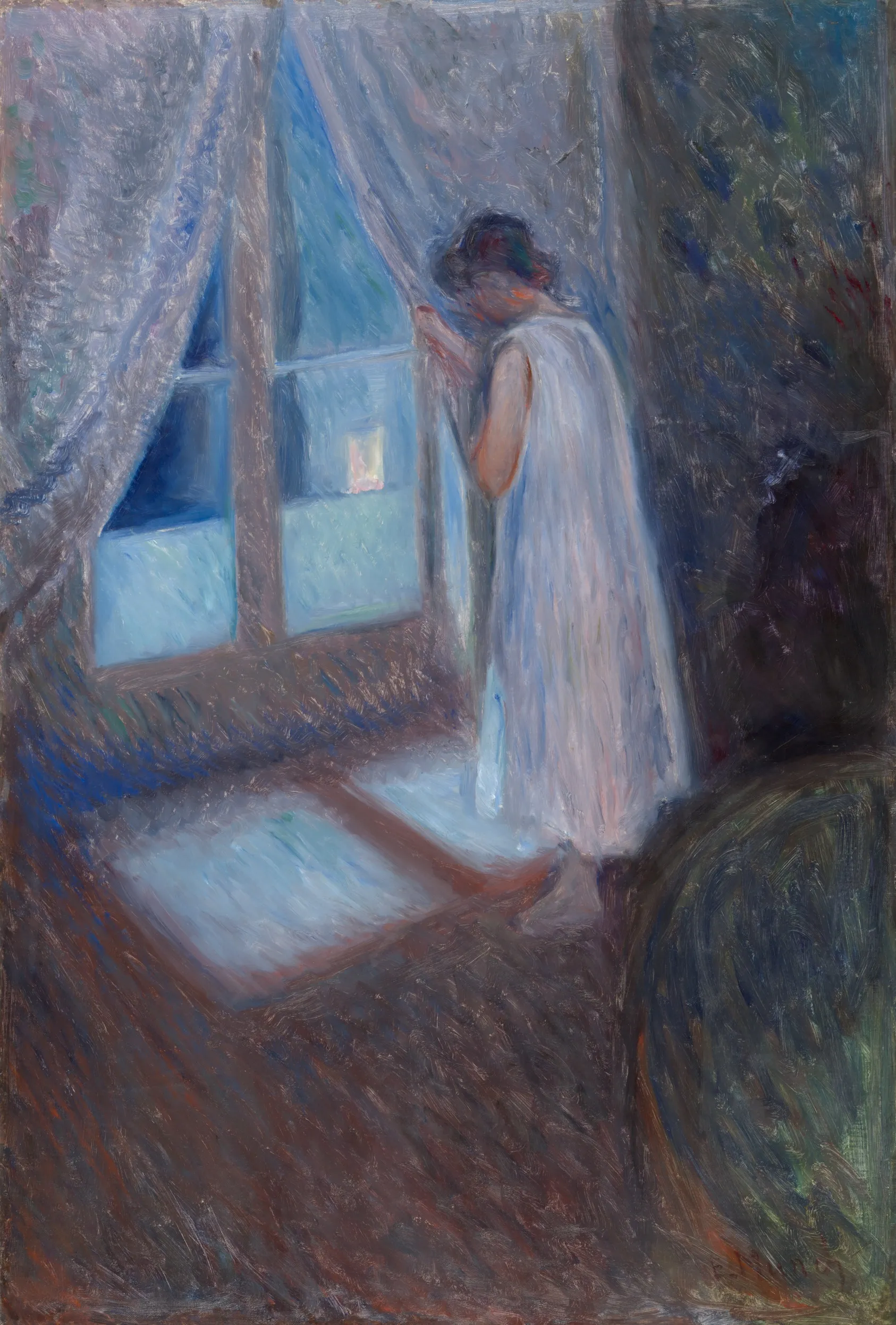
The works illustrating this guide are museum pieces in the public domain, and they mark where the modern begins. They could not be anything else: work by the artists these galleries actually sell is in copyright, and reproducing it here without permission would be precisely what this site promises not to do.
The Girl by the WindowEdvard Munch1893 · Art Institute of Chicago · obra 154235 · CC0
Modern and contemporary are not the same thing, and the price knows it
The category covers two markets that live under one roof and work in opposite directions.
The historical avant-garde —roughly the 1910s to the 1960s— is pure secondary market. The artist is dead, the work exists in a closed number, and auctions set the price. What decides value here is documentation: provenance, exhibitions, literature and, above all, whether the work appears in the catalogue raisonné. A piece outside the catalogue is not necessarily fake, but it is a disputed piece, and that is paid for downwards.
The living artist is the primary market. There is no resale history and no bidding: there is a price list the gallery holds and raises slowly as the artist shows in places that count. Buying here is not guessing a value: it is joining a project.
Confusing the two causes most of the disappointments. A living artist is bought for the work; the avant-garde is bought for the file.
What a gallerist does, and why they charge what they charge
The usual primary-market split is around fifty per cent with the artist, and that figure shocks anyone hearing it for the first time. It is worth knowing what sits underneath: the space and its months of rent, installation, insurance, transport, sometimes the production of the work itself, the catalogue, the cost of a fair —paid in advance and not recovered if nothing sells— and years of work placing that artist in collections that will hold their price.
What you pay above the studio price is that. It may strike you as a lot or a little, but it is an identifiable service, and it has a practical consequence: a gallery that only charges to exhibit is not a gallery. If the artist is asked for money to hang, the model is wall rental, and whoever buys there has nobody standing behind the work.
The price, and why it is not haggled like a flea market
In a gallery an artist’s price is public and has to be the same everywhere. If Madrid discounts by thirty per cent what a Basel fair charges at list, that artist’s market breaks, and the first casualty is whoever already bought.
Hence the two rules of the transaction:
- The courtesy discount is real —of the order of ten per cent, a little more for a regular collector or an institution— and asking is normal.
- A large, immediate discount is a warning, not a bargain. It says the starting price was not real.
What is negotiable without any friction is payment in instalments, and many galleries offer it. Asking costs nothing.
One warning about tax, because it changes the final price and almost nobody explains it: buying from the artist is taxed at 10 % and buying from a gallery at 21 %. It is set out in the VAT Spain charges on art, along with what that means — the tax makes the documented channel the expensive one.
The edition: what you actually take home
Outside unique pieces, almost everything here is multiple, and the number is everything.
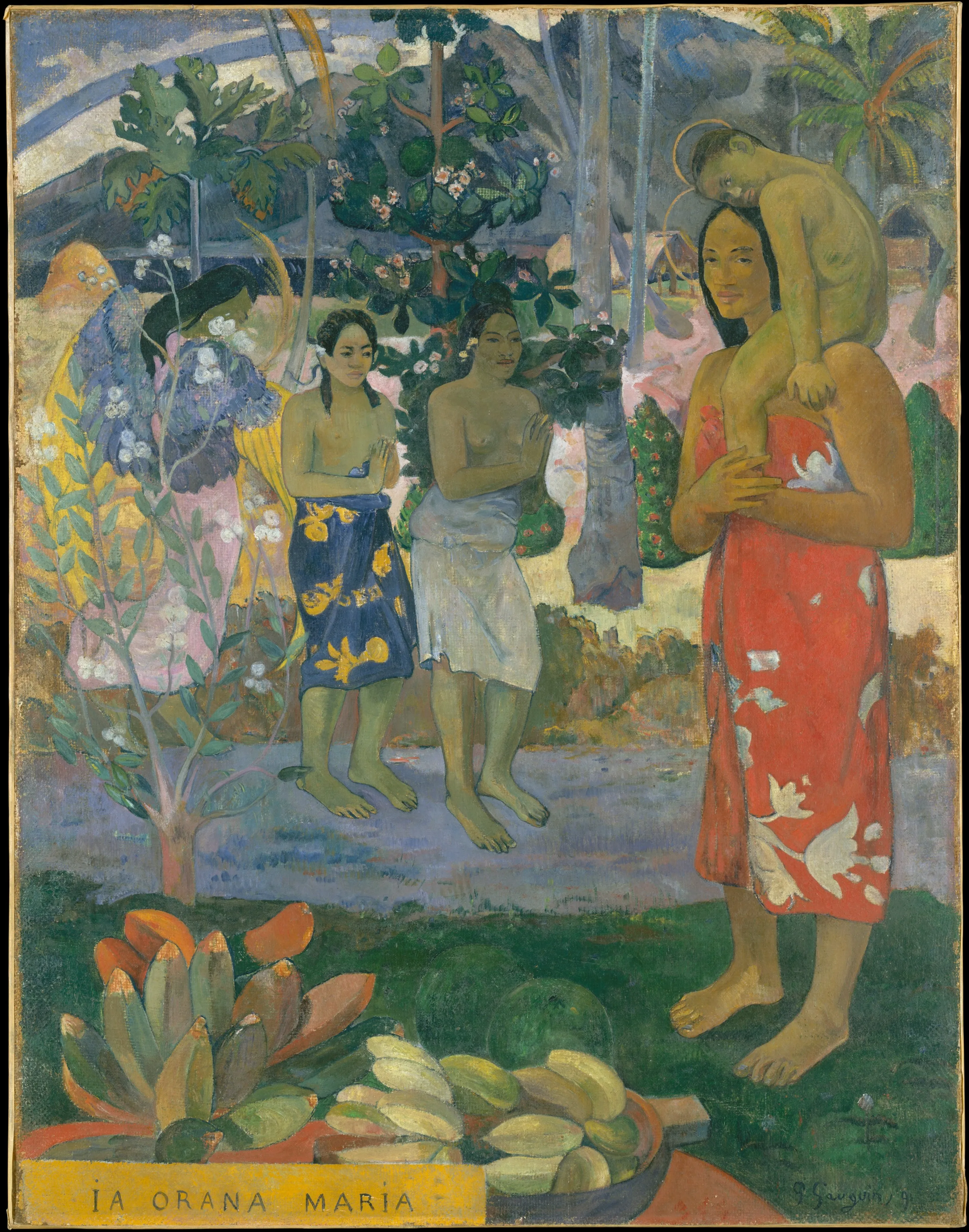
With an edition, what you buy is not 'a copy': it is one copy of a known total. If the total is not in writing, you do not know what you bought.
Ia Orana Maria (Hail Mary)Paul Gauguin1891 · The Met · objeto 438821 · CC0
In sculpture, short editions —three to eight— are standard for contemporary bronze, and each cast is numbered. Ask about artist’s proofs: they are legitimate and sit outside the numbering, but they count. An edition of 8 with 15 proofs is an edition of 23.
In photography, the edition is usually tied to size: the same image may have an edition of 5 large and 30 small. For pricing they are different works, and you have to ask about both.
In prints, the old rules apply, and they are set out in the guide to prints and drawings: numbering, technique, and a pencil signature in the margin.
And in video and installation, what changes hands is one copy with exhibition conditions, a carrier and a certificate — with a clause you need to check nowhere else: what happens when the file format becomes obsolete.
The paperwork
The object is different from an antique; so are the documents.
- An invoice with a description: author, title, year, technique, dimensions and, if it is an edition, the number and the total.
- A signed certificate. Here it is worth a great deal, unlike in antiques: if the artist or the gallery that represents them signs it, it is signed by someone in a position to know. A certificate from an anonymous third party is worth nothing.
- Conservation and installation conditions, when the work has them. Common in installation, works on paper and any unstable material.
- The resale right. Spanish law grants the author a percentage of a resale when a market professional is involved. You do not pay it when buying, but it is worth knowing it exists on the day you sell.
If what you are buying is historical avant-garde rather than living work, the question changes entirely: there, what you ask for is documented provenance, with particular care around the interwar years and the European post-war. How a chain of ownership is read, and why time does not always clean it, is in how to tell whether an antique is genuine and, in a real case, in sixteen years do not launder a stolen piece.
What reduces value
- Work with no declared edition. If nobody says how many exist, there is no scarcity to value.
- Restoration. In contemporary art it is far more serious than in antiques: materials are often industrial, unstable and unrestorable, and an intervention can void the work rather than repair it.
- Buying outside the circuit. Work obtained “through a friend” with no invoice and no certificate is work nobody will be able to place in twenty years.
- Poor framing or mounting. An acidic mount or a badly made plinth eats part of the price within two years.
What to ask before paying
- Do you represent this artist, or are you reselling?
- What is the list price, and is it the same at a fair?
- If it is an edition: of how many, and how many artist’s proofs?
- What exhibitions and which collections are behind this artist?
- What happens if I want to sell in five years? Will you help?
The fifth separates a gallerist from a seller. A gallery genuinely working with its artist cares where each work ends up, and an honest answer to that question —including an uncomfortable one— tells you more than the rest of the conversation.
Where all of this is visible at once
At a fair, where you can compare the same artist on two stands in one afternoon. Estampa has the lowest price floor and Swab the emerging work; the four autumn fairs, and what each one guarantees, are in four fairs in nine weeks.
And if what you need is someone to talk to, the directory of galleries is arranged by province, with the commission published and the rules we ask of them written into the pact.