Four fairs in nine weeks, and only one vets what is sold
Estampa, Swab, Loop and Feriarte pack the Spanish art autumn into nine weeks. What you buy at each, what each guarantees, and what to ask at the stand.
Estampa opens at IFEMA on 24 September. Sixty-six days later, on 29 November, Feriarte closes in the same halls. Two more fairs fit between those dates —Swab and Loop, both in Barcelona— and with them almost everything this trade shows in public all year.
It is usually told as a calendar: four boxes, four dates, write them down. We think that is the least useful way to tell it. The four sell different things, at prices that bear no relation to one another, and with guarantees that are not the same either — and that last difference, the one that decides the most money, is explained by none of the four on its own website.
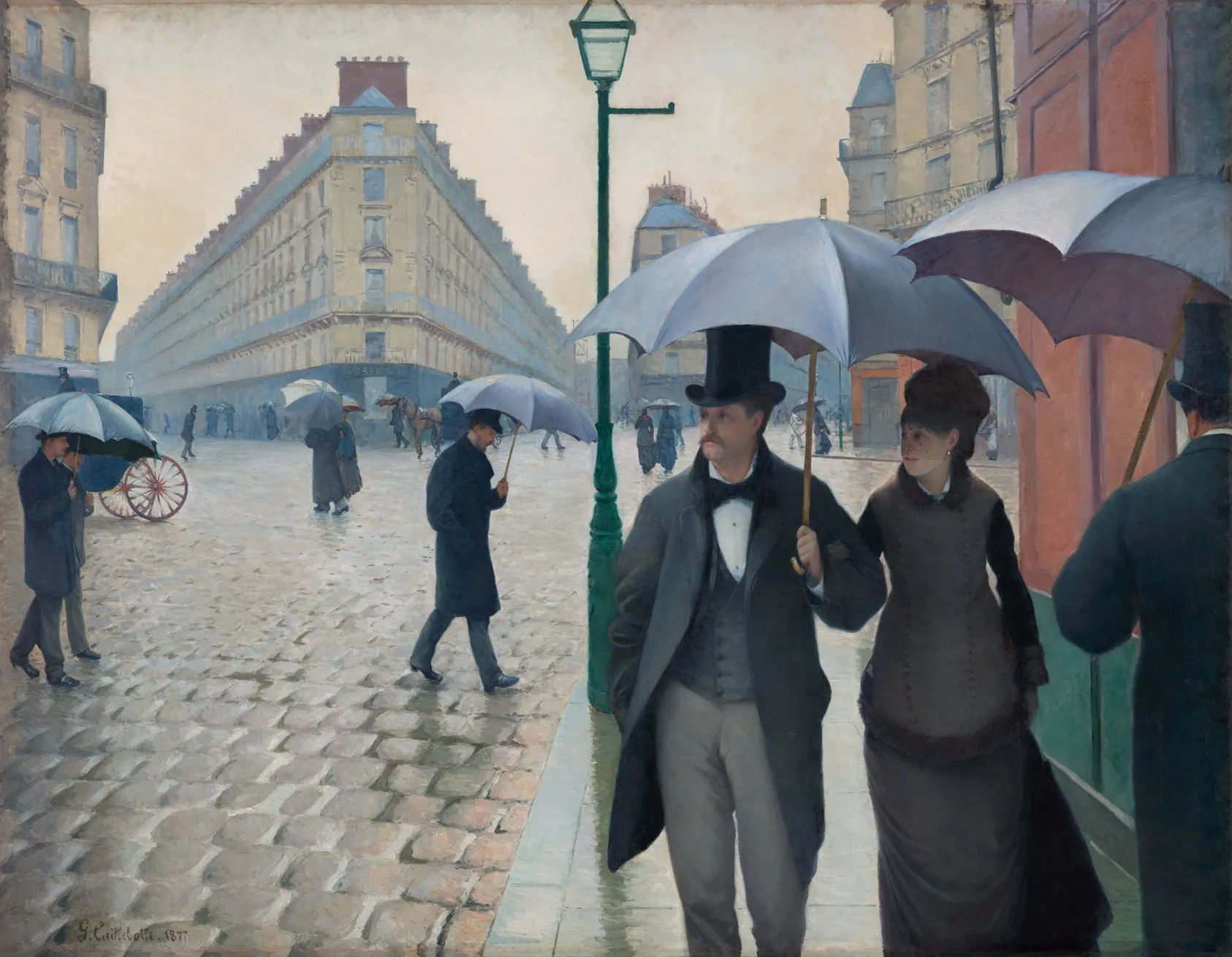
A fair is the closest thing this trade has to a street: for four days, houses that work on their own all year stand side by side, with the prices on show, answering anyone who walks past.
Paris Street; Rainy DayGustave Caillebotte1877 · Art Institute of Chicago · obra 20684 · CC0
The four, in one table
| Fair | When | Where | What you buy |
|---|---|---|---|
| Estampa | 24–27 September | IFEMA, Madrid | Prints and multiples by living artists |
| Swab | 8–11 October | Palau Victòria Eugènia, Montjuïc | Emerging contemporary art |
| Loop | 17–19 November | Barcelona | Video art |
| Feriarte | 21–29 November | IFEMA, Madrid | Classic antiques and galleries |
Three of the four belong to the gallery world. We will come back to that at the end, because it says a good deal about the trade.
Two committees with similar names that do different jobs
Almost every fair boasts about its committee. It is worth knowing that there are two kinds, and that only one of them looks at the objects.
A selection committee decides which galleries get in. It is standard at an art fair and it is a real guarantee, but an indirect one: it filters the seller, not the goods. What that exhibitor hangs on their stand is their own business.
An authenticity committee vets the pieces, before the fair opens, and can pull from a stand anything that does not hold up. On the Spanish calendar Feriarte is the one that has it, and it is what separates it from a large market: the filter is not applied by the person selling.
The distinction matters because it changes who you go to if something turns out wrong. With a selection committee, the gallerist. With an authenticity committee there is also a third party who already said yes. What neither of them is: a piece-by-piece appraisal with a signed report. A committee sharply reduces the odds of running into a blatant fake; it does not turn a debatable attribution into settled authorship, and it does not replace the invoice.
What comes down in price is not the work: it is the way in
The September and October fairs share something that is almost never said, and it is the reason they are worth visiting even if you buy nothing.
At Estampa you find original work by living artists for a few hundred euros. It is not minor work: a print is a piece conceived to be printed, with its matrix and its numbered edition, and for five hundred years it has been the way an image reaches more than one house. It is the lowest price floor on the whole calendar, and that is why it is the fair to start with.
At Swab the floor is low too, but for a different reason: you are buying artists who have no secondary market yet. That has to be said in full — as an investment, no. Most of the artists shown at an emerging fair will have no resale in ten years, and that is not a failing of the fair: it is the arithmetic of the trade. You buy emerging work because you like it and because it costs what you can pay. If it appreciates, that is a bonus, not the plan.
And both share the thing that really counts: fifty galleries in one hall let you see the same artist on two stands, at two prices, and ask why. You cannot do that visiting rooms one at a time in different weeks. You can go to a fair, buy nothing, and come out knowing three times as much.
A video does not go home under your arm
Loop is the odd one out, and we include it while saying so plainly: it is the only fair devoted to video art, and it is a niche that none of the houses in this directory currently works in.
It is worth understanding what changes hands there, because it clarifies something that applies to prints as well. You acquire one copy of an edition, with whatever exhibition conditions the artist sets, plus a carrier and a certificate. You do not buy the copyright: the artist keeps their rights, just as a painter keeps them over the image of their painting. And there is one clause that no other fair requires you to check: what happens when the file format becomes obsolete. Without a written undertaking that the artist or the gallery will supply the file in new formats, what you bought has a technical expiry date.
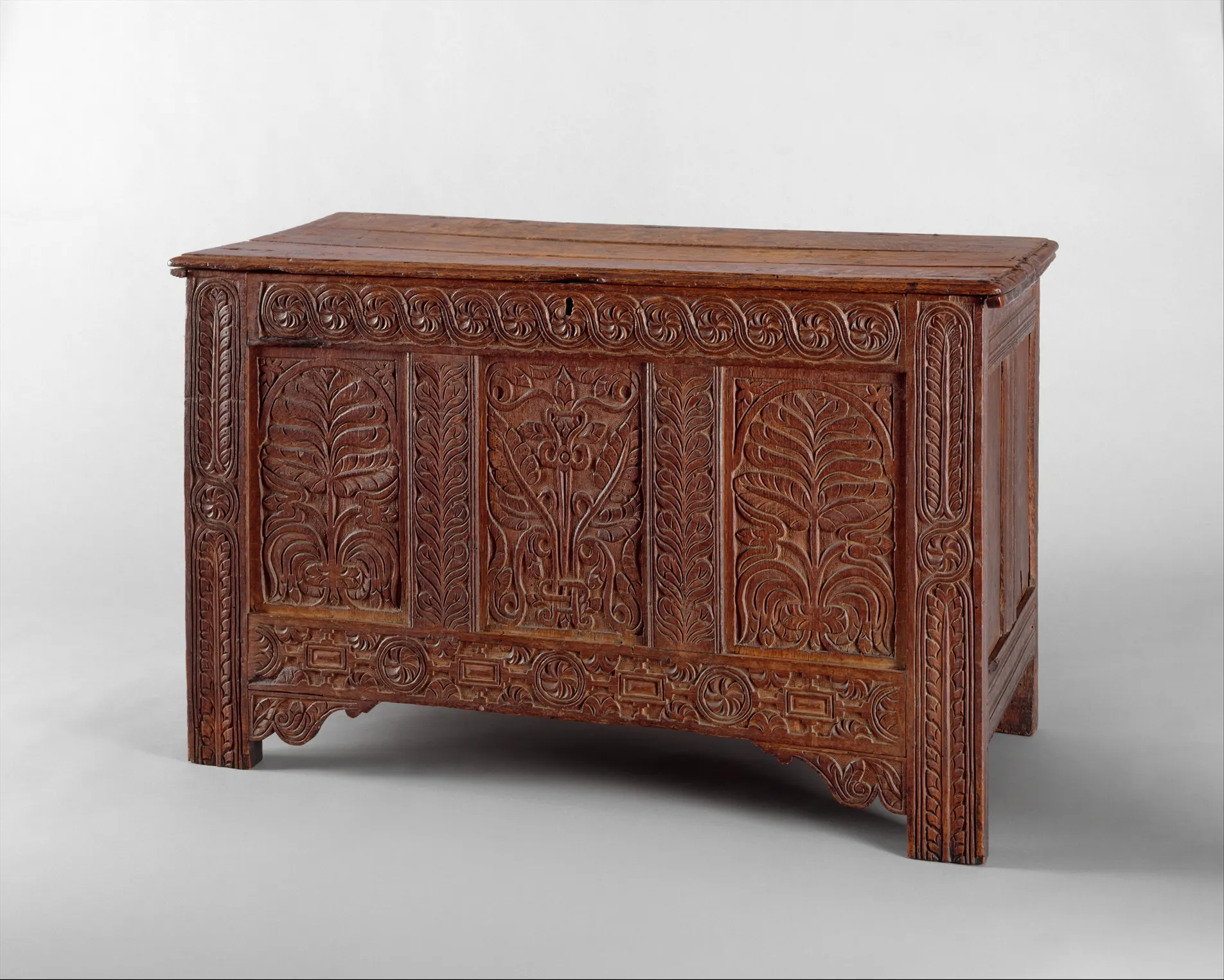
At an antiques fair a piece of furniture is examined exactly as it would be in a shop: from behind, underneath and inside the drawers. A committee does not change where you have to look.
ChestWilliam Searle1663–80 · The Met · objeto 1997 · CC0
Feriarte, and the antique dealer’s lopsided autumn
November brings the big one: more than a hundred exhibitors at IFEMA, nine days, and the place where more Spanish houses of the trade are seen together than anywhere else. Furniture, old master painting, silver, porcelain, clocks and period jewellery, with more weight on early material than its spring sister.
But look at the table again. Of the four autumn fairs, three are gallery fairs and only one serves the antique dealer. The dealer’s other date, Almoneda, falls in April and has no published dates yet. Which means the gallery world gets three public shop windows between September and November, and the cabinet gets nine days at IFEMA and then waits for spring.
This is not a reproach to anyone. It is the same asymmetry visible in the trade bodies —galleries have a national association that can call people out; antique dealers are spread across provincial associations that run no joint campaign— and it explains why half the market appears in the picture far less than its share of turnover would suggest.
What to ask for at the stand, whichever fair it is
The object changes; the paperwork does not.
- An invoice with a description, not a receipt. Author or workshop if there is one, period, materials, dimensions and —the item always forgotten— the restorations. A rebuilt chest or a clock with a replaced movement is not worth the same, and that has to be in writing, not said out loud on a noisy stand.
- The numbering, if it is an edition.
12/75is impression twelve of seventy-five. The first number says nothing about quality; the second says everything about scarcity. - How the tax is charged. Asking whether they apply the second-hand goods scheme, and on what base the VAT is calculated, is not impertinent: it changes the final price, and in Spain art still pays the standard rate while the rest of Europe has cut it.
- The awkward question. What happens if an independent expert says this is not what you say it is? A serious house has the answer ready, and it is written into the pact we ask of the houses listed here.
One practical thing: take a ten-power loupe. It tells a print from a photomechanical reproduction —the regular dot grid gives it away— and it is the single check that saves the most money on the whole calendar.
This list expires
The full calendar carries the dates the organisers have confirmed, including ARCO in March. But it is worth saying out loud what an article like this is: on 30 November it is good for nothing.
That is exactly the difference between this section and the tools, which never expire. A directory of silver hallmarks can wait. Estampa is on 24 September, and anyone who finds out on the 25th can do nothing with the information.