Prints are the way into collecting: you can start with hundreds of euros rather than tens of thousands, and you can buy work by first-rank names. It is also where most people pay the price of an original for a reproduction, because the vocabulary is designed —sometimes deliberately— to be confused.
This guide is about telling them apart by looking at the sheet.
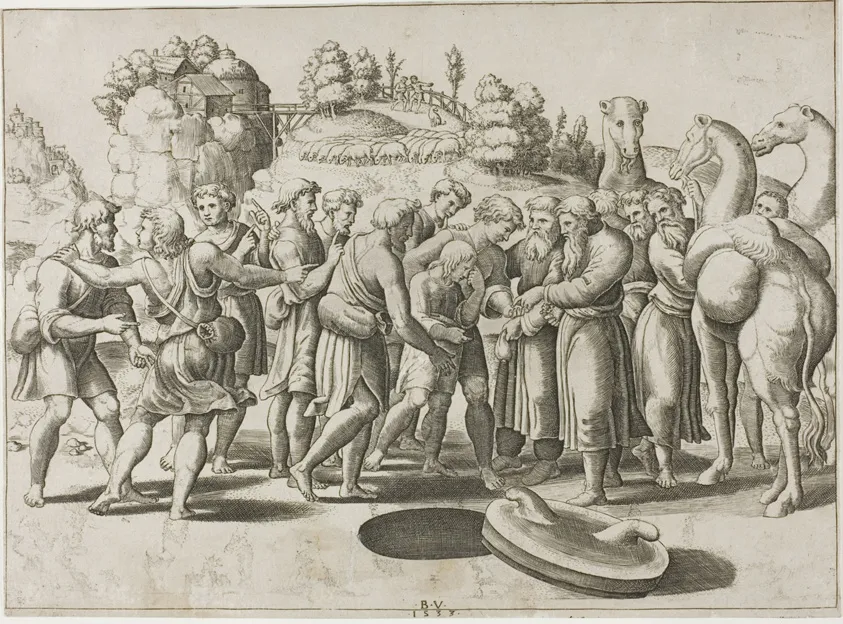
Burin engraving, 1533. The density of the line, its capacity to swell and thin within the same stroke, is impossible to imitate with a reproduction: it is matter deposited in the paper, not ink sprayed onto it.
Joseph Sold by his BrothersMaster of the Die1533 · Art Institute of Chicago · obra 34 · CC0
First: original does not mean unique
In painting, «original» means a unique piece. In printmaking it means something else, and that is where the confusion starts.
An impression is original when the artist conceived the matrix —the plate, the stone, the screen— in order for it to be printed. That seventy-five copies exist does not make it less original: all seventy-five are.
It is a reproduction when the starting point is a work that already existed —usually a painting— copied by photomechanical means. Even signed in pencil, numbered and on good paper, it is still a photograph of a painting.
The whole price difference in this field rests on that distinction, and it is not visible in the signature. It is visible in the surface.
The three families, and how to recognise them with a loupe
Intaglio — burin engraving, etching, drypoint, aquatint. The metal plate is incised, the ink sits in the grooves and the paper picks it up under pressure.
The signal: the platemark. The edge of the plate leaves a rectangular depression in the paper, perceptible to the touch and visible in raking light. And the ink stands in relief: run a fingertip along a thick line and you will feel it. If you are sold an etching with no platemark, either the plate was larger than the sheet —rare— or it is not an etching.
Lithography — drawn with a greasy medium on limestone or zinc. There is no incision, so there is no platemark and no relief: the surface is completely flat.
The signal: under a loupe you see an irregular, organic grain, which is that of the stone or the greasy crayon. An offset reproduction —also flat— instead shows a regular grid of dots in perfect alignment. That grid is the conclusive proof that a camera was involved.
Screenprinting — the ink is pushed through a mesh. Flat, saturated layers of colour with the very slightest relief to the touch; the edges between colours are crisp, with no gradation.
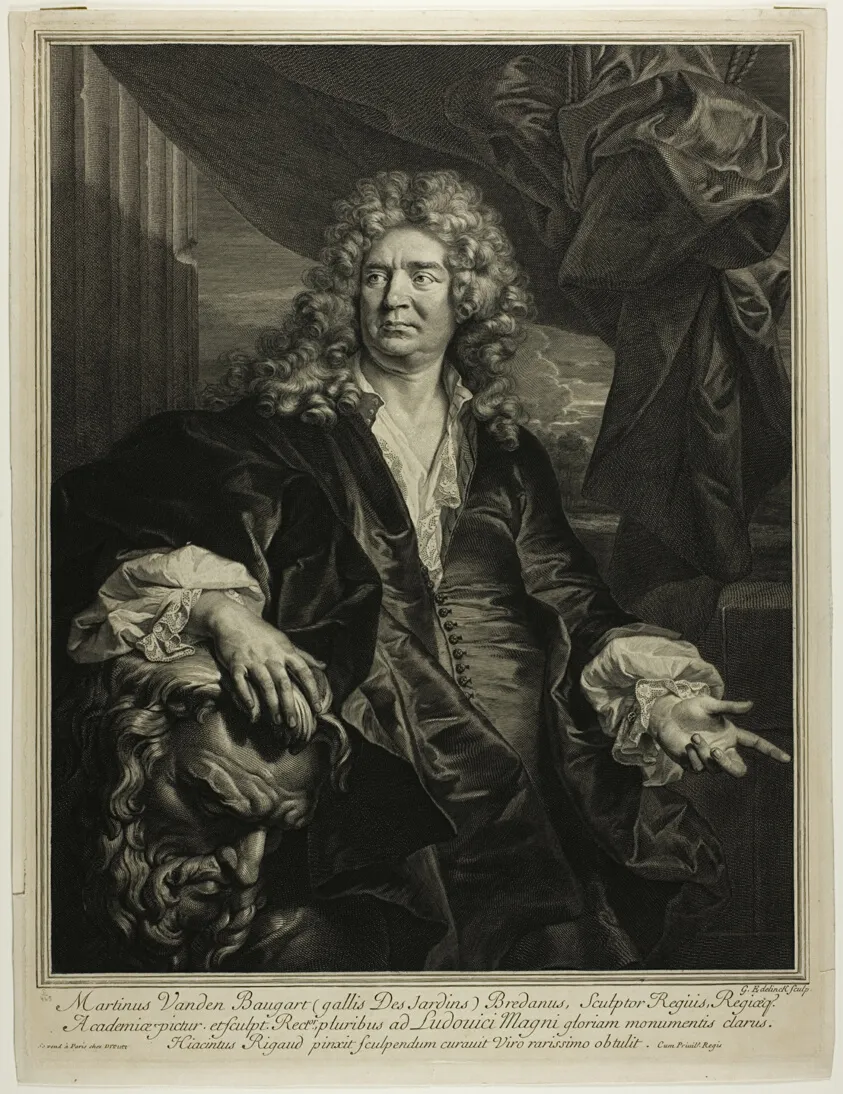
Engraving and etching combined. Look at the hair and the lace: the tone is built from crossed lines of varying thickness, something a mechanical screen never achieves because its dots are all identical.
Martin Vanden Bogaert DesjardinsGérard Edelinckn.d. · Art Institute of Chicago · obra 111 · CC0
A ten-power loupe is the best purchase you will make
It costs less than the commission on any transaction and settles most doubts in twenty seconds. What you are looking for:
- Regular dots in a grid, aligned in rows and often in four colours → photomechanical reproduction. End of discussion.
- Irregular grain or a line of varying thickness → a matrix made by hand.
- Dots of unequal size and random distribution → aquatint or grained lithography, which are artist’s techniques.
An honest qualification: today’s high-end photomechanical work is very good, and there are techniques —giclée on rag paper— that deceive the naked eye. Under a loupe, not yet.
How to read the margin
The lower margin almost always carries three things written in pencil. In pencil, not printed: if the «signature» is inside the image and in the same ink as the drawing, it is part of the plate and not an autograph signature.
On the left, the numbering. 12/75 is impression twelve of seventy-five. The
first number says nothing about quality —they are numbered at the end and in no
order— so do not pay a premium for a 1/75. The one that matters is the second:
scarcity is what holds the price.
In the centre, sometimes, the title.
On the right, the signature and often the year.
And the abbreviations that replace the numbering:
| Mark | What it is |
|---|---|
| P/A, E/A, A.P. | Artist’s proof, outside the edition |
| H.C. | Hors commerce, not for sale |
| B.A.T. | Bon à tirer: the impression approved as the model. Unique |
| P/E | State proof, from an intermediate phase of the plate |
The B.A.T. is the most interesting of the set: it is unique by definition and it is the one the workshop used as the reference for the whole edition.
The three warning signs
The enormous edition. Editions of one thousand, three thousand or «unnumbered» are publishing product, not collector’s material. And watch the arithmetic: an edition of 150 plus 50 artist’s proofs plus 30 H.C. plus a run in Roman numerals is 250 impressions, not 150. Ask for the real total.
A plate signature sold as autograph. Many old prints carry the signature engraved in the matrix itself, and it appears on every impression. That is legitimate and normal; what is not legitimate is charging for it as a signature by hand.
Trimmed paper. If the margins have been cut flush with the image, the numbering, the signature and much of the value have gone. It also makes the platemark impossible to see. An old print with generous margins is worth considerably more than the same one with its margins guillotined to fit a frame.
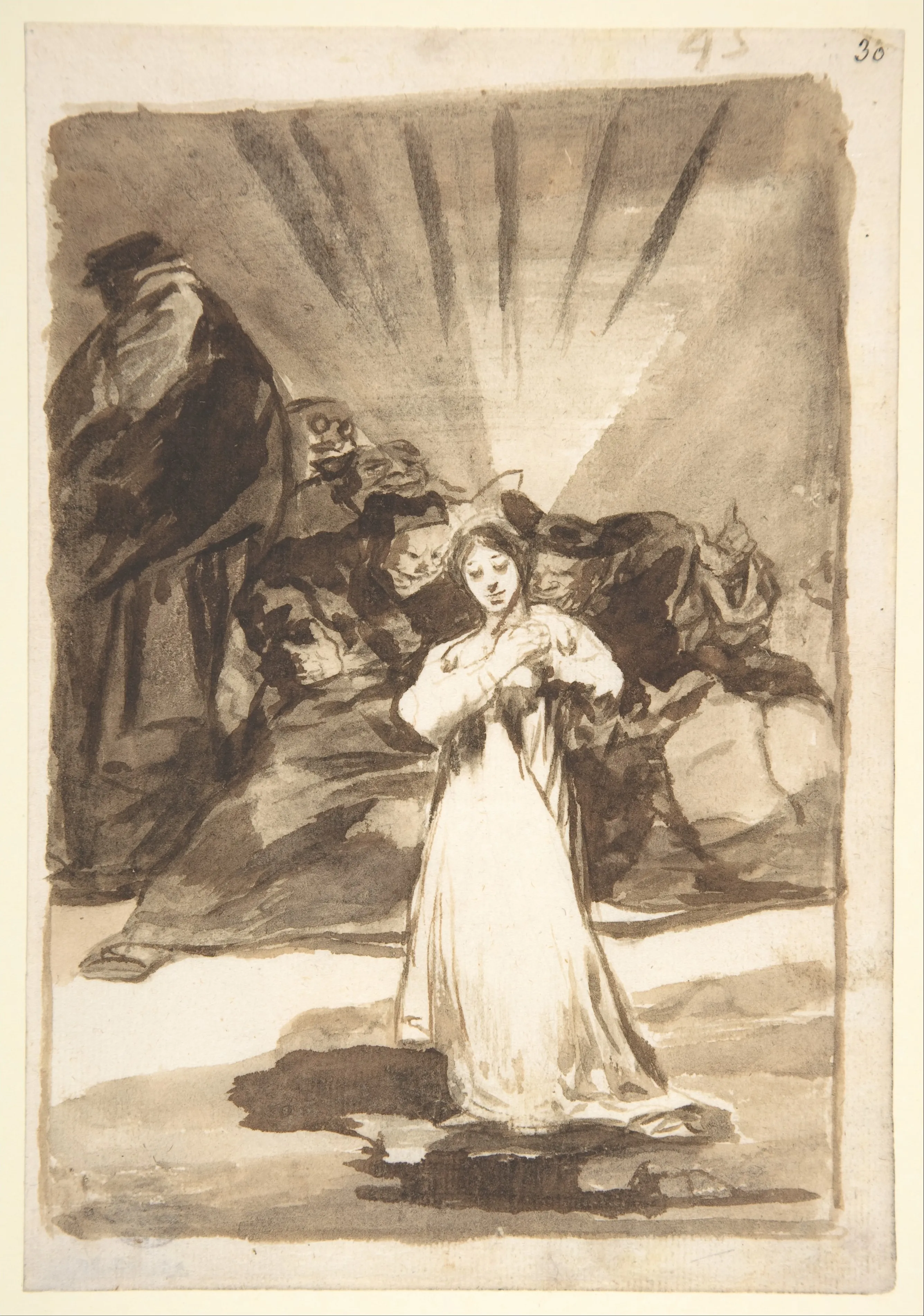
Goya, circa 1812–20. In drawings and prints of this period the paper is as informative as the image: fibrous, deckled and watermarked. A modern optical brightener under ultraviolet would rule the piece out in a second.
A radiant female figure beset by dark spirits; page 45 from the "Images of Spain" Album (F)Goya (Francisco de Goya y Lucientes)ca. 1812–20 · The Met · objeto 334030 · CC0
Condition, which in works on paper is almost everything
Paper is the most fragile support in the art market, and its pathologies are visible without instruments:
- Foxing: brown spotting, caused by damp and fungus. Very common and partially treatable, but it takes value off.
- Acid burn: if it was mounted with poor-quality board, a dark band appears exactly where the mount touched.
- Light burn: the part that was on view fades relative to the part covered by the frame. Irreversible.
- Traces of adhesive tape on the reverse: they stain and are difficult to remove without damaging the fibre.
Ask to see the sheet out of its frame. A serious seller has no objection, and there are things —the reverse, the deckle, the watermark, past repairs— that cannot be seen any other way. If they refuse, you already have an answer.
What is paid in this market
Four factors, in order of weight:
- The name. As everywhere, but here the difference between a first-rank name and a secondary one is enormous, because there are many impressions of both.
- Real scarcity. A short edition and a plate cancelled at the end.
- Condition. It weighs more than in painting: there is no way to replace lost fibre or restore the original white.
- Complete margins. It is surprising how much they are worth.
And one practical observation. To start collecting, an old print by a secondary artist in immaculate condition is a better buy than a modern impression by a great name in an edition of two thousand. The first is genuinely scarce; the second is merely famous.
Where to see all this in one place
A fair is where this guide can be used in a single afternoon: fifty galleries, the same artist on two stands at two prices, and a loupe in your pocket. Estampa is the one in the Spanish calendar devoted to prints, and the cheapest place to start. The rest are in the fairs calendar.