Buying from the artist pays 10; from a gallery, 21
Spain is the only EU country that has not cut VAT on art. What the directive says, why Brussels has taken Spain to court, and who the tax really penalises.
Between 2 and 7 February this year, hundreds of art galleries across Spain shut their doors on purpose. It was not a workers’ strike: it was a strike of shopfronts, called by the trade itself against the 21 % VAT levied on the sale of a work of art in this country.
On 18 February, gallerists and artists staged sit-ins in four museums. On the 16th of that same month the Senate had unanimously approved a motion urging the Government to cut it. In June there was a demonstration outside the Ministry of Culture.
Today, six months on, it is still 21 %.
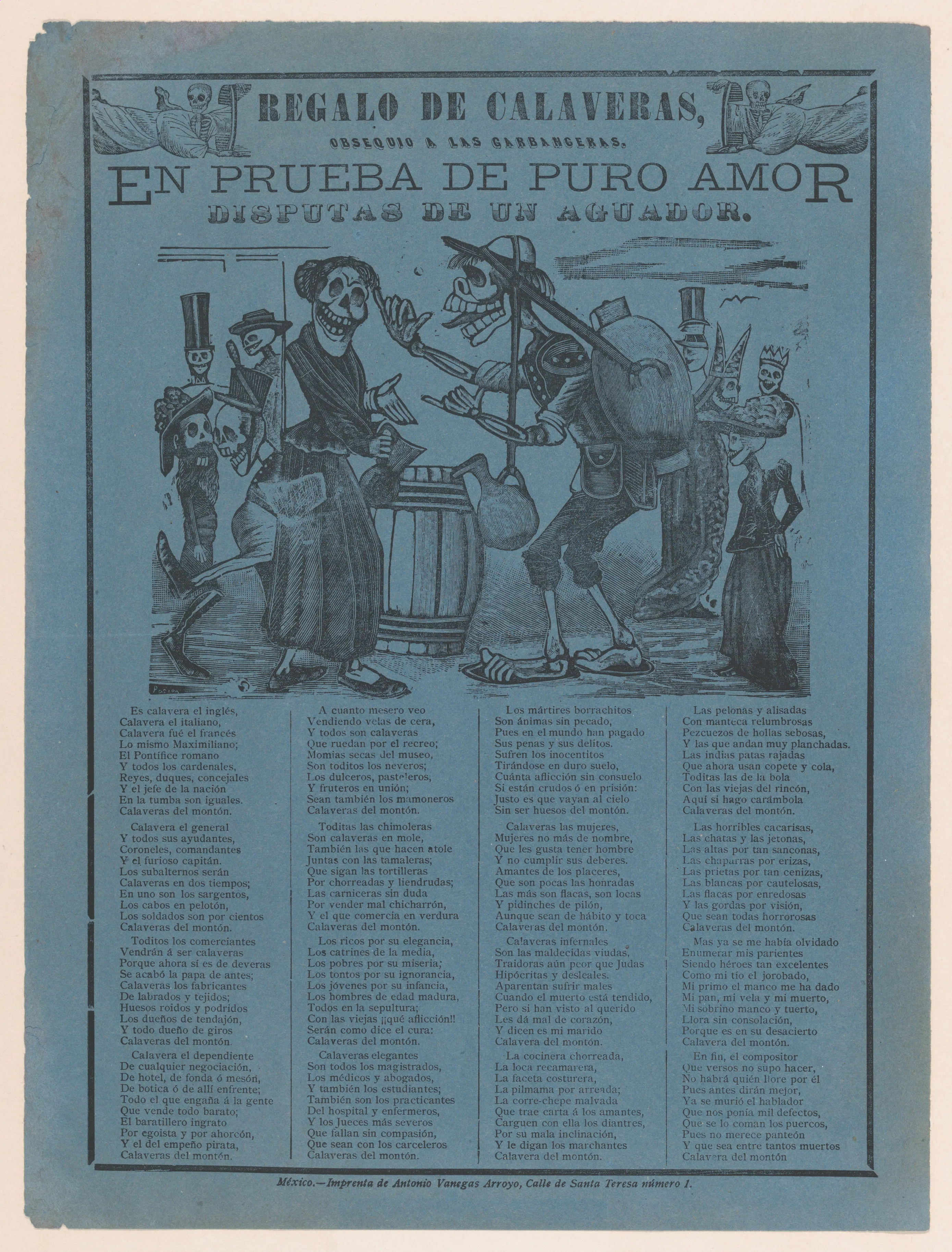
Calavera by José Guadalupe Posada, c. 1890-96, type-metal engraving. Posada printed cheaply and in long runs precisely so that his work would circulate and say something: of all the techniques, printmaking is the one born closest to the street.
In proof of true love, a watercarrier skeleton arguing with a woman (Posada); two skeleton angels in upper corners (Manilla)José Guadalupe Posadaca. 1890–96 · The Met · objeto 729644 · CC0
Ten or twenty-one, depending who sells it to you
What almost nobody explains is that in Spain art does not have one VAT rate: it has several, and they depend on the middleman.
- Buy a work directly from the artist who made it — or from their heirs — and the rate is 10 %.
- If that same work comes through customs, imported from outside the EU, the rate is also 10 %, whoever the importer is.
- Buy that same work from a gallery or an antique dealer and the rate is 21 %: the standard rate, the highest there is.
One honest qualification, because the trade often repeats this wrongly: professional sales usually fall under the margin scheme for second-hand goods, in which case the 21 % applies not to the full price but to the dealer’s margin. It is not 21 % on what you pay. But it is still the standard rate applied to a cultural good, and it is still more than double what the same object pays one country over.
Within Spain the comparison is harder still to defend. Cinema, theatre and music are taxed at 10 %. Books and the press at 4 %. The visual arts at 21.
What Brussels said
In April 2022 the Council adopted Directive (EU) 2022/542, which expressly allows member states to apply reduced rates — down to a minimum of 5 % — to supplies of works of art, collectors’ items and antiques.
The deadline for transposing it was 31 December 2024. What happened next is a matter of public record and it is short:
- January 2025: the Commission sends Spain a letter of formal notice.
- July 2025: a second warning, the reasoned opinion.
- 7 May 2026: the Commission refers Spain to the Court of Justice of the EU for a “grave and persistent” failure to comply.
The Commission line that carries the most weight is not the rebuke but the fact: “All other member states have already completed transposition within the deadline set.” It is not that Spain is late. It is that Spain is the only one that has not gone at all.
Meanwhile: Italy 5 %, France 5.5 %, Belgium and Portugal 6 %, Germany 7 %.
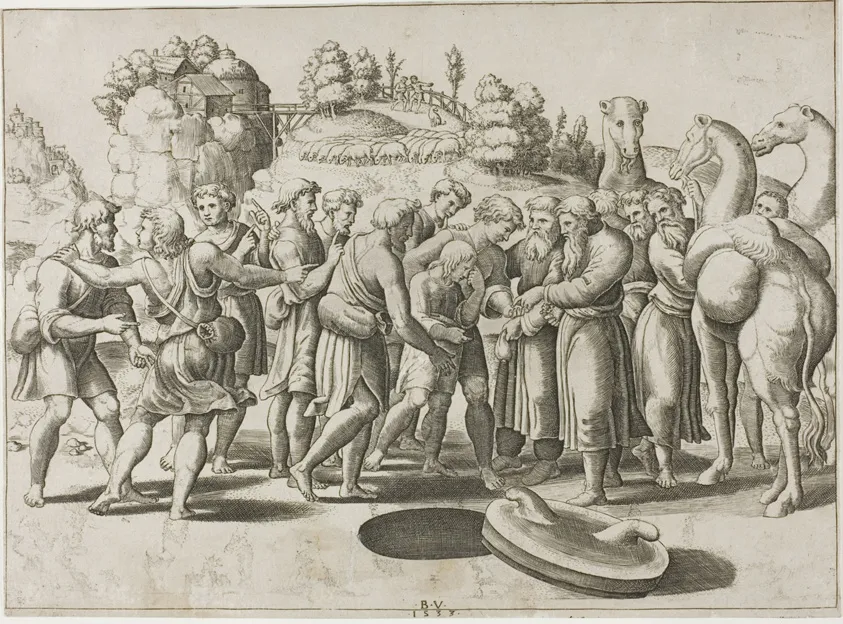
Joseph Sold by his Brothers, Master of the Die, 1533. A sixteenth-century engraving is exactly the kind of piece you can only buy safely through a channel that issues an invoice and documents provenance: on your own, you cannot tell a period impression from a later printing.
Joseph Sold by his BrothersMaster of the Die1533 · Art Institute of Chicago · obra 34 · CC0
The tax rewards the channel that documents nothing
Here is what strikes us as the heart of the matter, and we have not read it in any of the reporting on the campaign.
A tax does not only collect: it pushes. And this one pushes in a particular direction. The purchase taxed most heavily is precisely the one that goes through an identified professional, with an invoice, a guarantee and a provenance you can pursue. The one taxed least — or not at all — is the one made hand to hand, in cash, with no paperwork.
Put another way: the design of the tax makes the counter expensive and the back-room cheap. Anyone who has followed the path of a stolen piece knows where that leads; we wrote about it days ago in sixteen years do not launder a stolen piece, where the object was recovered precisely because at some point it entered a channel that publishes what it sells.
We are not saying 21 % created the opaque market: it was there before. We are saying it does not help, and that a country claiming to want traceability should not charge a surcharge for using it.
And the antique dealer, absent from every photograph
The European directive speaks of “works of art, collectors’ items and antiques”. All three.
But this year’s campaign — the February closure, the museum sit-ins, the June demonstration — has been carried almost single-handedly by contemporary art galleries. Antique dealers are affected in exactly the same way by the same article of the same directive, and have not appeared in a single photograph.
This is no reproach to anyone: galleries have a national association that can call an action, while antique dealers are spread across ten provincial associations that have run no joint campaign. But the upshot is that half the affected market is having its own VAT negotiated without being at the table.
What this changes for a buyer
Little, for now, and it is worth saying plainly: until Spain transposes, you pay what you pay. Three practical things in the meantime:
- Always ask how it is invoiced. Asking whether the margin scheme applies and what base the tax falls on is not impertinent: it is information the dealer has, and it changes the final price.
- The artist’s 10 % is real and it is legal. Buy living work directly from the studio and that is your rate. It makes the purchase neither better nor worse: it makes it different, and without the guarantee an accountable middleman gives you.
- Do not let the tax push you. The difference between a piece with an invoice and one without is not measured in VAT points: it is measured the day a third party turns up claiming ownership.
If any of this does move, it will move at the Court of Justice and not at a demonstration. And when it moves, it will move the antique trade too — whether or not it happens to be watching.