The antique clock is the most transactional category in the trade: whoever is looking almost always knows what they want, by maker and model. That makes it a comfortable market to buy in and a difficult one to improvise in.
And it has a trap of its own that does not exist in painting or furniture: a clock is three objects in one —case, dial and movement— and all three can be separated and recombined. Most of the trouble comes from there.
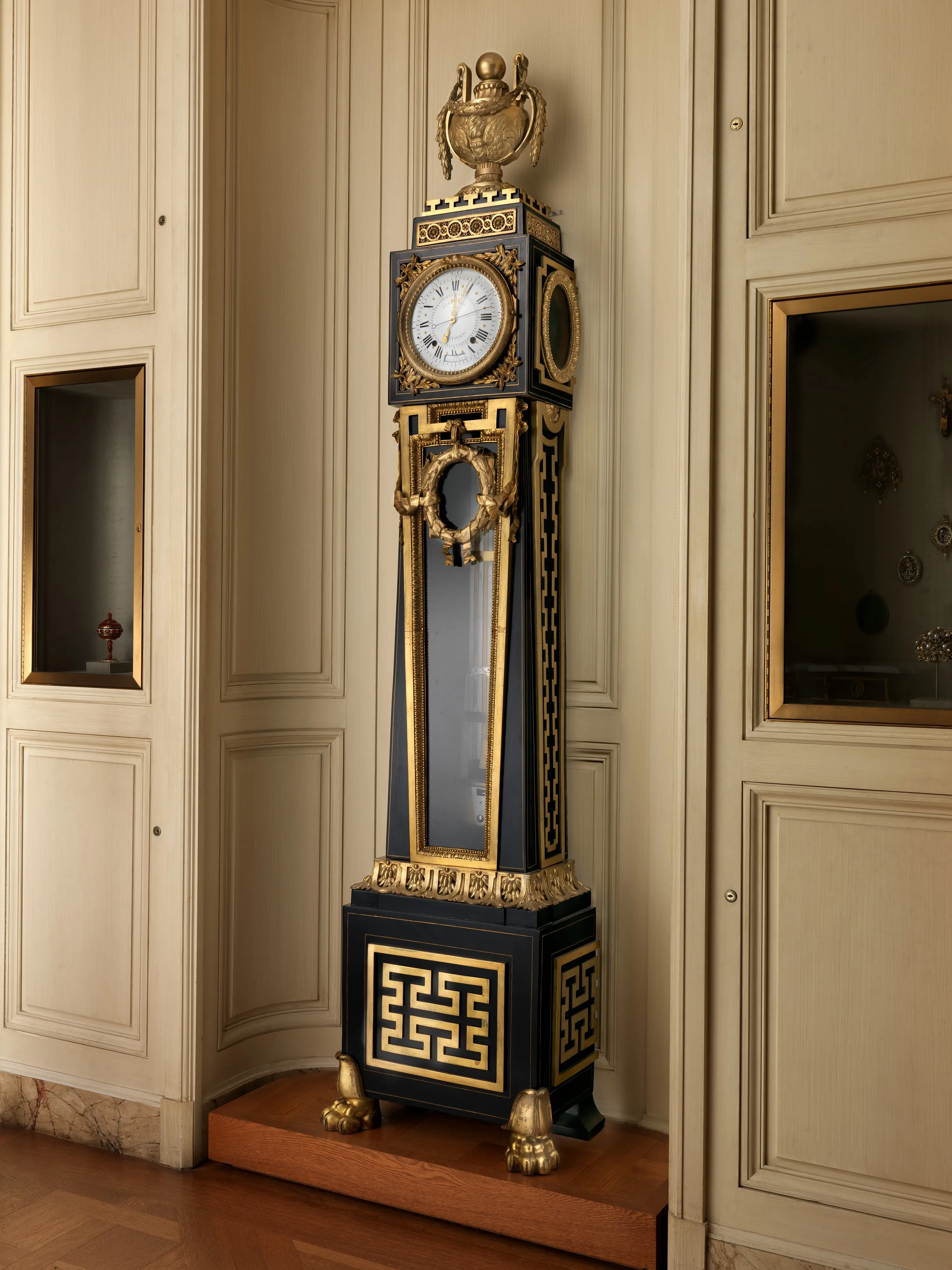
Astronomical regulator by Ferdinand Berthoud, circa 1768. An austere dial with all the ambition placed in the movement: in a regulator what is paid for is precision, not decoration.
Longcase astronomical regulatorFerdinand Berthoudca. 1768–70 · The Met · objeto 206965 · CC0
First: open the door and look at the movement
If the seller will not let you see the mechanism, the visit is over.
Is it complete? Check that the weights, the pendulum, the key and —on striking clocks— the hammer and the bell or gong are all there. They are missing very frequently, and replacing them with correct period parts is not cheap.
Is it its own? Here is the most common fraud in the category. Look for:
- Unused screw holes in the case, a sign that it housed another movement.
- Play between the movement and its recess: the original fits.
- Signatures that do not match between dial and plate.
- A movement that is too clean inside a case with two centuries of life.
Is it mechanical? Check that a quartz movement has not been fitted inside an old case. It sounds like a joke and it is done constantly with wall clocks: look for a battery, and see whether the seconds hand advances in one-second jumps rather than sweeping.
The dial is the face, and the part most often touched
It is the part most people «improve» and where most value is lost.
An original enamel dial has fine craquelure, some chipping at the edges or around the arbor holes, and a tone that is not pure white.
A repainted dial is too uniform, the numerals have slightly different weights from one another —because they have been done by hand on top— and frequently the clockmaker’s signature has disappeared, which was the most valuable thing on it.
On a brass or silvered dial, look at the wear: it has to be where the hands sweep and where it has been cleaned over decades, not spread evenly.
And the hands: they should be consistent with each other and with the style of the dial. A pair of modern hands on an eighteenth-century clock is cheap to fit and expensive to discover afterwards.
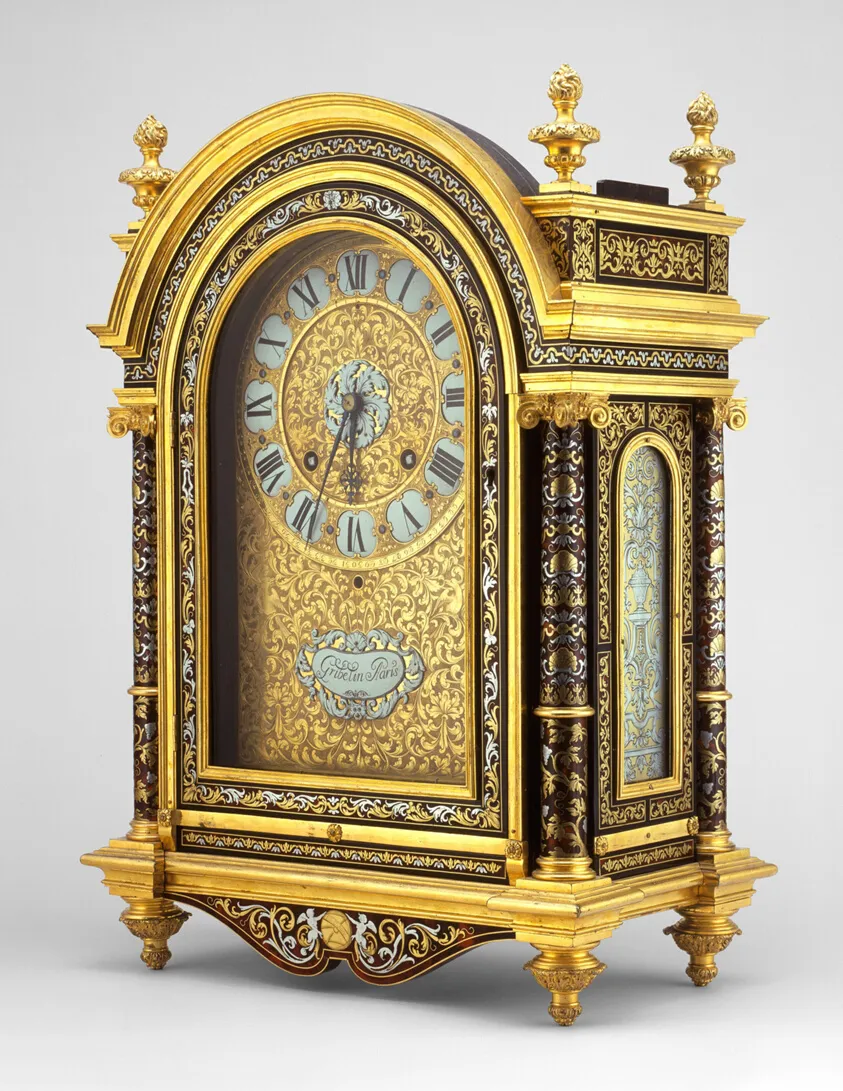
Table clock by André-Charles Boulle, circa 1675. Here the case is not the packaging for the clock: it is the piece. Brass and tortoiseshell marquetry over an ebony carcase, and a movement to match.
Table ClockAndré Charles Boullec. 1675 · Art Institute of Chicago · obra 156887 · CC0
The case, which is sometimes worth more than the clock
In clocks of great cabinetmaking —Boulle, French cartel, English longcase— the case can be most of the price. What you look at there is the same as in any piece of furniture: lifting veneer, marquetry with losses, bronzes regilded in a modern way, and above all whether case and movement have been together from the start.
One revealing detail: in a longcase, look for the pendulum mark on the floor of the case. A pendulum has swung in the same place for two hundred years and leaves a trace. If there is no trace, or the trace does not match the present pendulum, the pairing is recent.
What takes value away
| Repainting the dial | A great deal. Among the worst things that can be done |
| Changing the movement | Enormous. It stops being the same clock |
| Polishing the bronzes to a shine | A great deal. It takes the gilding and the patina |
| Replacing hands | Considerable, and easy to detect |
| Cleaning and oiling the movement | None. It is maintenance |
| Replacing a broken glass | Little |
What to ask
- Is the movement the original one for this case?
- Is it complete: weights, pendulum, key, striking?
- Is the dial repainted or original?
- When was it last serviced, and by whom?
- Does it run right now? May I see it going and striking?
- Is it a marriage? And if so, of which parts?
The sixth has to be asked directly and using that word. A professional in the field understands it and answers it; discomfort at it says a good deal.
What is paid
At the top: clocks signed by documented makers, precision regulators, complications —repeating strike, calendar, automata— and any piece with an exceptional case.
At the bottom: the ordinary nineteenth-century French wall clock, of which hundreds of thousands were made. And there is the good news for anyone starting: they are mechanically good, there are spares, there are people who repair them, and they cost little. As an investment they will not move; as a first clock it is hard to do better.
The blind spot of the Spanish market: the English longcase of the eighteenth and nineteenth centuries sits clearly below its price in the United Kingdom. It is large, and we already know what happens to large things in a country of flats. If you have the ceiling height, it is among the best buys the category offers today.