Antique jewellery has one peculiarity it shares with no other category in the market: it can be melted down. Any piece has a guaranteed minimum value —its metal and its loose stones— and that means thousands of historical pieces have disappeared into the crucible because somebody valued them by weight. Buying well, and selling well, starts with knowing when a piece is worth far more than its materials.
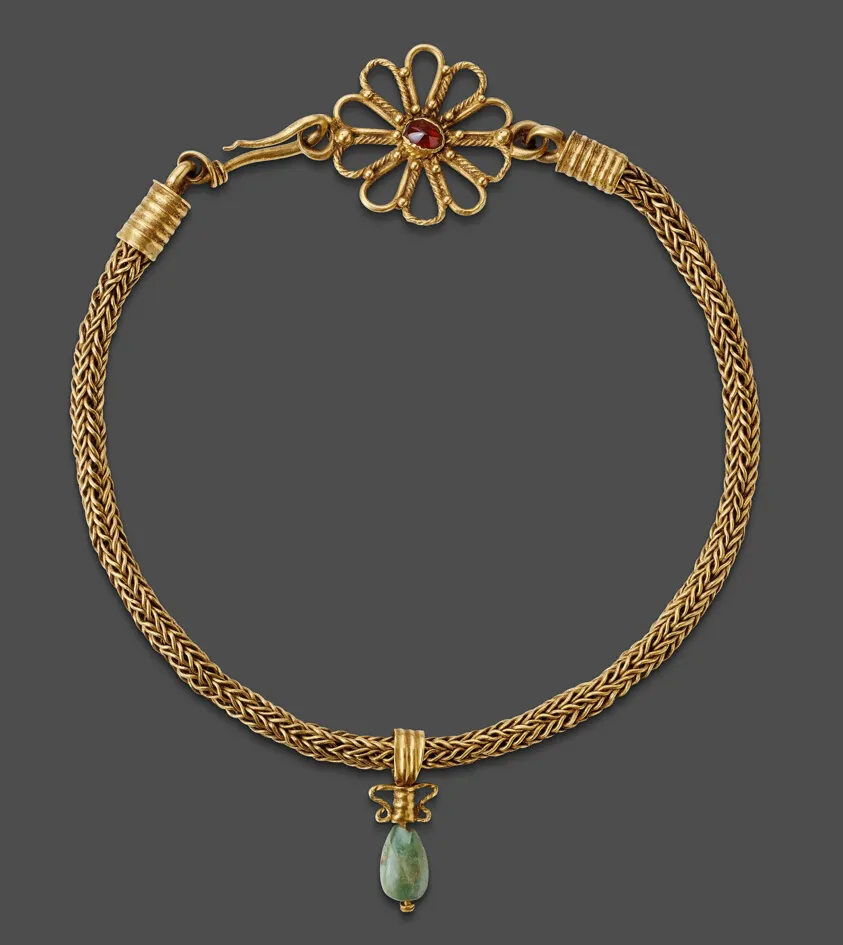
Roman necklace with pendant, second to third century. Two thousand years later, what holds the price is not the weight of the gold but that the piece is still whole and that its origin is known.
Necklace with PendantAncient Roman2nd-3rd century · Art Institute of Chicago · obra 807 · CC0
Hallmarks are the identity document
Look for them with a ten-power loupe in the places nobody looks: the inside of a ring shank, the tongue of a necklace clasp, the back of a brooch, the edge of a mount.
There are usually three kinds, and each says something different:
- The standard mark, indicating the purity of the metal —750 for 18-carat gold, 925 for sterling silver— and which on antique pieces may appear as a crown, a head or a figure depending on country and period.
- The maker’s or workshop mark, almost always initials inside a geometric shape. It is the one that can transform the price if the workshop is recognised.
- The assay mark, the office that certified the standard. It changes by city and by period, and it is what allows a piece to be dated and located.
Two practical warnings. The absence of a hallmark condemns nothing: compulsory marking is recent and uneven between countries, and there are genuine nineteenth-century pieces with no mark at all. And the reverse: a hallmark can be added, so on an important purchase the hallmark accompanies the report, it does not replace it.
Spanish silver has a system of its own on top of that, with three marks to a piece and none of the national date table England provides. How to read it is set out in Spanish silver hallmarks.
The cut of the stones dates the piece
Here is the indication hardest to fake, because faking it means destroying material.
Antique cuts were made by hand and for candlelight: they sought large, slow flashes, not the scintillation of modern jewellery. They are recognisable by three features:
- A deep pavilion — the lower part of the stone is taller.
- A small table — the flat upper facet occupies less.
- A visible culet — looking face on you see a small flat dot at the centre, which does not exist in the modern cut.
Today’s brilliant cut, with its 57 calculated facets, is 1919 onwards. And here is a piece of advice that runs against instinct: do not recut an antique stone to a modern cut. It gains scintillation and loses weight, history and value. A well-preserved old mine is worth more than the brilliant it would become.
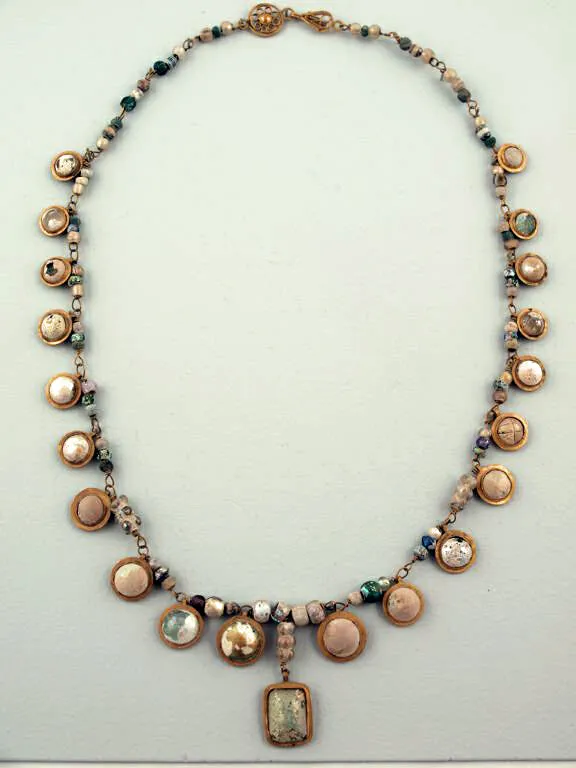
Byzantine necklace, circa fifth century. The goldsmith's work —the plaiting, the soldering, the finish— is what separates a museum piece from its weight in gold. Melting it down would have yielded a few grams.
NecklaceByzantineprobably 5th century · Art Institute of Chicago · obra 65681 · CC0
What separates a piece from its weight in metal
Four things, and it is worth knowing which one you are paying for:
The workshop. A recognised name multiplies. And we are not only talking about the international names: Spanish silverwork and jewellery of the nineteenth century, and Catalan modernisme, have identifiable and collected workshops.
Integrity. A complete piece, with its original clasp and its original stones, is worth disproportionately more than the same one with a modern clasp. The clasp is among the parts most often changed, and among those that give most away.
Period design. Georgian, Victorian, Art Nouveau, Art Deco: each period has recognisable features and a demand of its own. Deco, with its geometry and its contrasts, is the most sought after today.
Provenance. As everywhere, but here with a nuance: jewellery is inherited and almost never carries paperwork. Any documentation —a family photograph with the piece being worn, an old invoice, an insurance receipt— is worth more than it seems.
The warning signs
«Antique gold» without stating the standard. It is the formula that avoids saying the piece is low carat, plated or vermeil. Ask for the number.
Plate sold as gold. With a loupe, look for wear on the edges and the points of friction: if a different metal shows through underneath, it is plate. Marks for plate exist —«plaqué», «rolled gold», «doublé»— and are perfectly legitimate; what is not legitimate is charging for them as solid gold.
Replaced stones. Look at whether all the stones in a piece share the same cut and the same tone. A modern one among antique ones announces itself: it is more symmetrical and brighter than its neighbours.
A pearl necklace with no report. The difference between natural and cultured is enormous and cannot be seen. For a large sum, X-ray.
What to demand in writing
On the invoice, not out loud:
- Metal and standard, with the number.
- Stones: type, approximate weight, cut and whether there are treatments.
- Pearls: natural or cultured.
- The period of the piece, and whether the design is of the period or later.
- Known repairs and replacements.
And the closing question, the same as always: what happens if an independent gemmologist contradicts the description. A serious jeweller has an answer ready.
Where the value is today
Antique jewellery is one of the few categories both trades sell: it is found in galleries and with antique dealers, and also in jewellers’. That widens the market and also the spread of prices: the same piece can be valued very differently depending on who you ask, and it is worth asking more than one.
And an observation on the market: cameos and Victorian mourning jewellery are cheap —taste changed— while Deco and modernisme are expensive. If you are buying for pleasure and not as an investment, in the first there is exceptional work at prices that will not be seen again when taste turns once more.