Spanish silver hallmarks: how to read the marks
Spain never had a national hallmarking system. Which three marks a piece carries, why the standard was not 925, and how to spot solid silver.
Reviewed on
With English silver you can be categorical: there is a national system, a table of date letters and an exact year for almost any piece. With Spanish silver there is not. Marking here was municipal for centuries — each city with its guild, its assayer and its own mark — so no single table settles the question.
That has a practical consequence worth accepting up front: reading a Spanish piece means locating it, not dating it to the year. This page is about what to look at, and in what order.
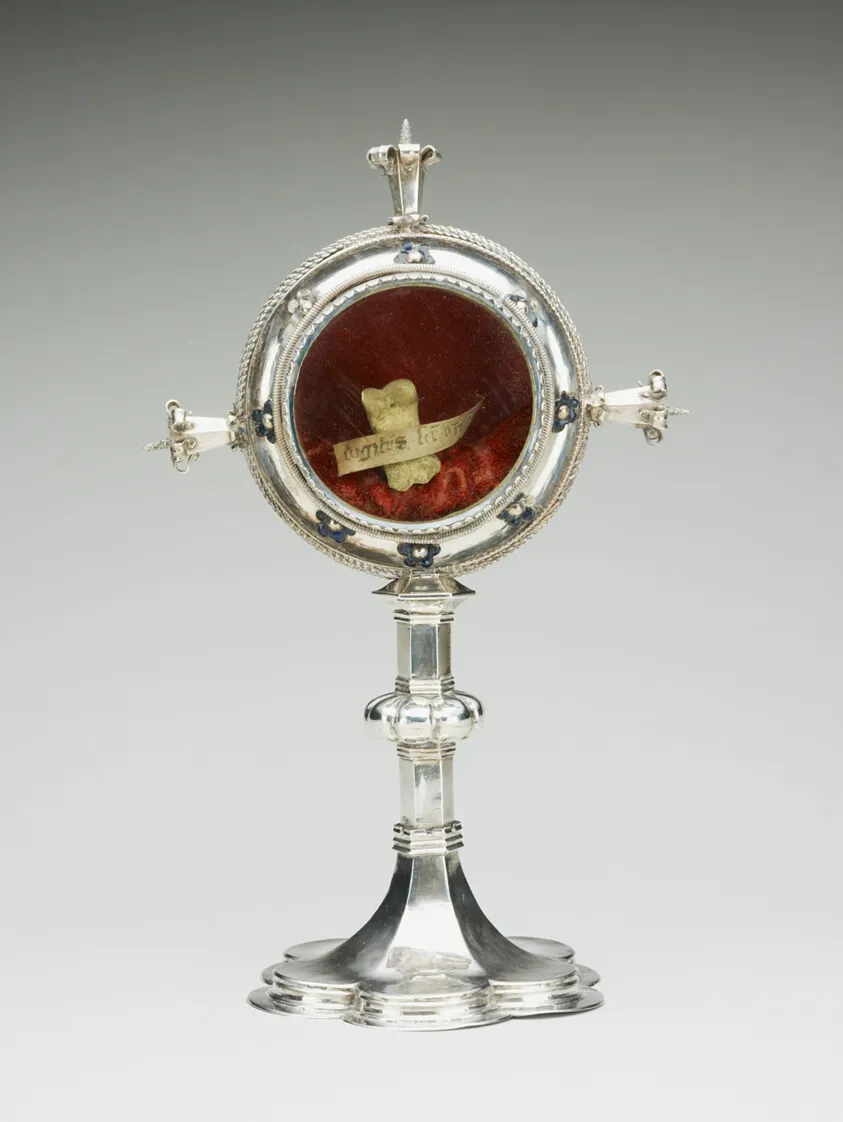
Silver reliquary monstrance, 1450-1500. Church silver was for centuries the largest commission in the Spanish trade, and it is where marking was taken most seriously: work on this scale went through the assayer without exception.
Reliquary Monstrance with a Relic of Saint Christina1450/1500 · Art Institute of Chicago · obra 88416 · CC0
The three marks a Spanish piece carries
Until the late nineteenth century a properly marked piece carries three punches, each answering a different question:
- The maker’s mark. The silversmith who made it, almost always a surname or initials. It is the signature, and it is what drives the price when the name is documented.
- The town mark. The city where the piece was assayed — not always where it was made. Córdoba used a rampant lion; Valencia used “VALE” first and later a crowned L. No two are alike and there is no short list: each centre has its own literature.
- The assayer’s mark. The fiel contraste, the public officer who tested the metal and stood behind its standard. This is the most useful of the three, because it identifies a person with known years in office, and that narrows the date far better than the rest.
To those three a date mark is sometimes added, with two digits of the year. It appears exceptionally in the seventeenth century and becomes common in the eighteenth. If you find one, half the work is done.
The standard was not 925, it was eleven dineros
This is the mistake people make most often when hunting for marks on an old Spanish piece: they expect to find a “925” and they will not.
Castilian law expressed fineness in dineros and granos, not thousandths: twelve dineros was pure silver and the requirement was eleven dineros and four granos. Thousandths come much later, with modern legislation. A “925” struck on a piece claimed as eighteenth-century is not reassurance: it is a warning, because that way of stating the standard did not exist when the piece was supposedly made.
The 1934 star settles arguments
Of all the Spanish marks, the one that resolves fastest is the most recent: from 1934, the five-pointed star within a circle became the official Spanish assay mark.
It says nothing about who made the piece or where. It says something simpler and very useful: the piece postdates that year. When something is offered as nineteenth-century and carries the star, the conversation is over.
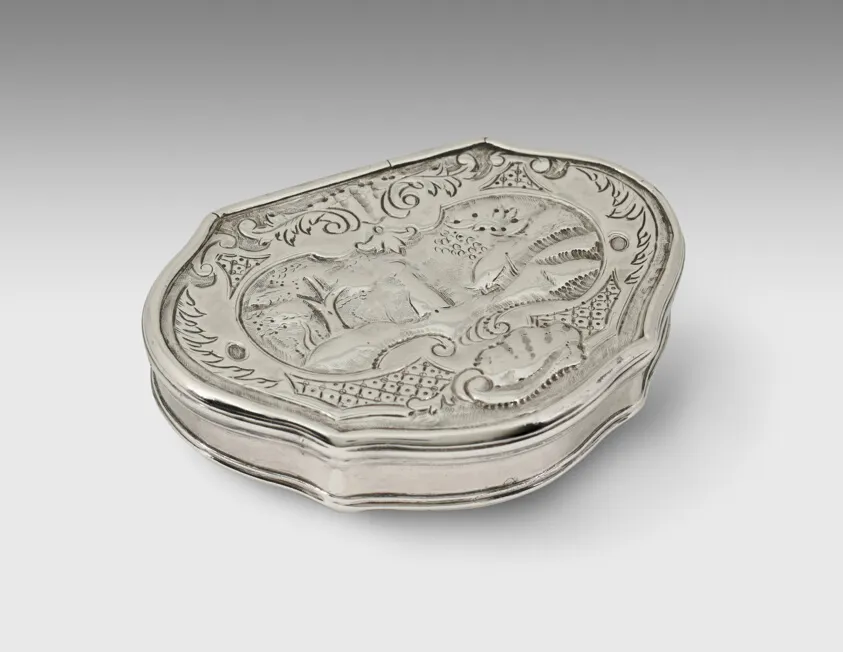
Silver snuff box, Thomas Dane, 1752. Small objects are where marks survive best and are hardest to see: here a ten-power loupe is not an affectation.
Snuff BoxThomas Dane1752 · Art Institute of Chicago · obra 99024 · CC0
A piece over a hundred years old needs no modern mark
This is worth stating with the statute open, because it causes real confusion in a purchase. Current law — Ley 17/1985 on articles made from precious metals — requires assay before sale, and recognises three standards for silver: 999, 925 and 800 thousandths.
But its article 2 expressly exempts objects more than a hundred years old. In other words, a genuinely antique piece sits legally outside that system, and demanding a modern mark of it is asking for something the law does not.
Hence the working rule: on a modern piece, a missing assay mark is a problem. On an antique one, it means nothing on its own.
How to tell solid silver when there is no mark
With no reliable punch, the physical signs are what is left, and none decides alone:
- The colour of the tarnish. Silver forms a sulphide and goes black with a blue cast. Green is copper and brown is usually brass: either way the piece is not what it claims.
- Wear on the rims. Plating goes first where things rub — edges, handles, the base — and a yellowish or grey metal shows underneath. On a solid piece a worn edge is still the same colour.
- The weight. Silver is noticeably heavier than alpaca of the same volume. It is not a measurement, but two like pieces in the hand are easy to tell apart.
- The lettering on the back. “EPNS”, “metal blanco”, “alpaca” or “silver plated” all mean the same thing: there is no silver here to value.
And the standing warning, which matters more here than anywhere: a mark can be added. Striking a false punch into a genuine white-metal piece is cheap and it is done. That is why on a purchase of any size the mark accompanies an assay report, it does not replace one.
The order worth following
- Look for marks where nobody looks: the base, the inside of the foot, the edge of a handle, the flange of a lid
- Count them: three distinct marks is the classic Spanish pattern
- Look for figures: two digits are a year; three are thousandths and therefore modern
- Check for a five-pointed star, which dates the piece after 1934
- If there is no mark, go to the metal: colour of the tarnish and wear on rims
- Set what the marks say against what the object says, and be suspicious when they do not agree
Hallmarks on jewellery follow the same logic, with different marks at a different scale: that is covered in the guide to buying antique jewellery. And if what you have in front of you is a dealer to buy from rather than a piece to read, the directory of antique dealers is arranged by province.
And for everything around the mark —what separates sterling from plate, why melting is usually the worst deal, and what destroys the value of a piece— there is the guide to buying silver and metalware.
Hallmarks answer only one of the four questions hiding inside “is it genuine?”. The other three —period, authorship, and whether the piece can lawfully be sold— are in how to tell whether an antique is genuine.