How to tell whether an antique is genuine
Genuine is four questions, not one, and the costliest is the one almost nobody asks. What you can check, what needs a document, and what each attribution means.
Reviewed on
The question looks like one and it is four. A piece can be eighteenth century, be sterling silver, never have left the workshop it is attributed to, and have gone missing from a parish church in 1994. The four answers are independent: you can fail one and be right about the other three.
- Is it from the period it claims?
- Is it what it claims to be? — material and technique.
- Is it by whom it claims? — authorship.
- Can it be sold? — ownership and provenance.
They run from the cheapest to check to the most expensive. And the fourth — the only one that can cost you the whole piece even when the other three are sound — appears in almost no guide.
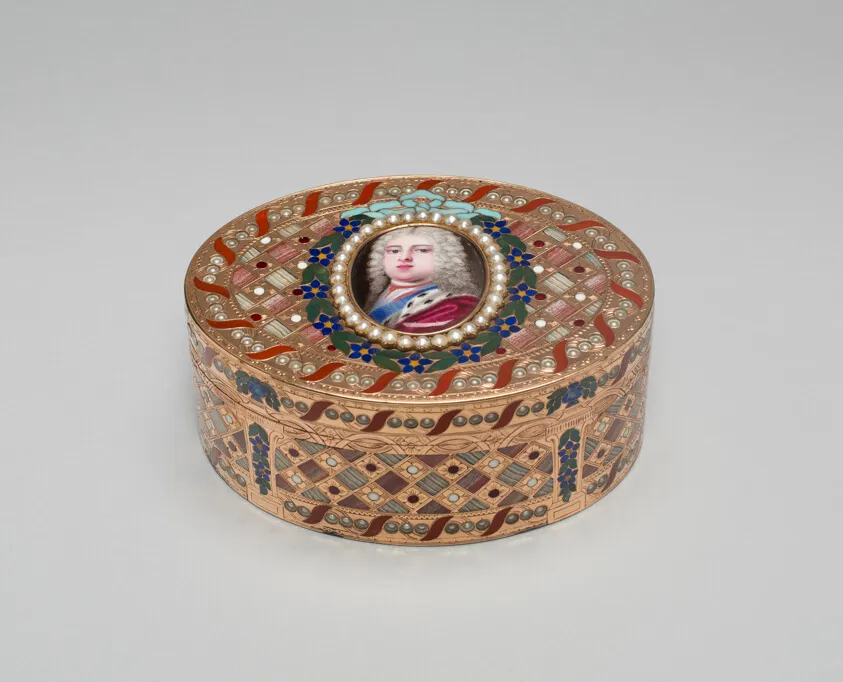
Snuff box with a portrait, about 1775. Small expensive objects are the most faked and the least examined: they fit in the hand, they are bought standing up, and almost nobody turns them over in front of the seller.
Snuff Box: Portrait of Saxon PrinceJohann Christian Neuberc. 1775/80 · Art Institute of Chicago · obra 80332 · CC0
One · Is it from the period it claims?
This is narrowed down by looking at how it is made, not at how it looks. Each material has its own check and each is set out separately: furniture by the drawers and the screws, painting by the support and the craquelure, silver by the assay marks. If what is in dispute is whether the piece even reaches antique status, that has its own boundary in antique, vintage or retro.
What belongs here is the rule that applies to all of them, and it is the most useful line on this page:
Do not look for perfection: look for coherence. An object that has lived two hundred years is worn where it is touched —the edge of a drawer, the arm of a chair, the rim of a tray— and not where it is not. Old timber shrinks across the grain and not along it, so a turning that was round is now slightly oval. Dirt gathers in the corners nobody cleans, not in the ones on show.
What is suspicious is not the wear: it is wear spread evenly, or wear where no hand has ever reached. The same goes for repairs: any piece two centuries old has been repaired. The rarity is one with no repairs at all.
Two · Is it what it claims to be?
The cheapest to settle and the one that saves the most money, because here you are not arguing an attribution: you are arguing a material.
Silver or plate. Silver tarnishes to a bluish black. Plating wears through first on rims and handles, and a yellowish metal shows underneath.
Bronze or spelter. Bronze is heavy and cold to the touch; zinc alloy —spelter, zamak— weighs far less and scratches white. In sculpture there is a further question, surmoulage: a bronze cast from another bronze comes out around two per cent smaller and with soft detail, like a photocopy of a photocopy.
Ivory or bone. Bone has canals —small dark dots and lines, visible with a loupe— while ivory shows a very fine crosshatched pattern.
Solid or veneered. Look at the edge and inside a drawer: thin veneer over pine shows in the cut. It is not a fraud —good furniture has been veneered since the eighteenth century— but it is not worth what solid timber is worth.
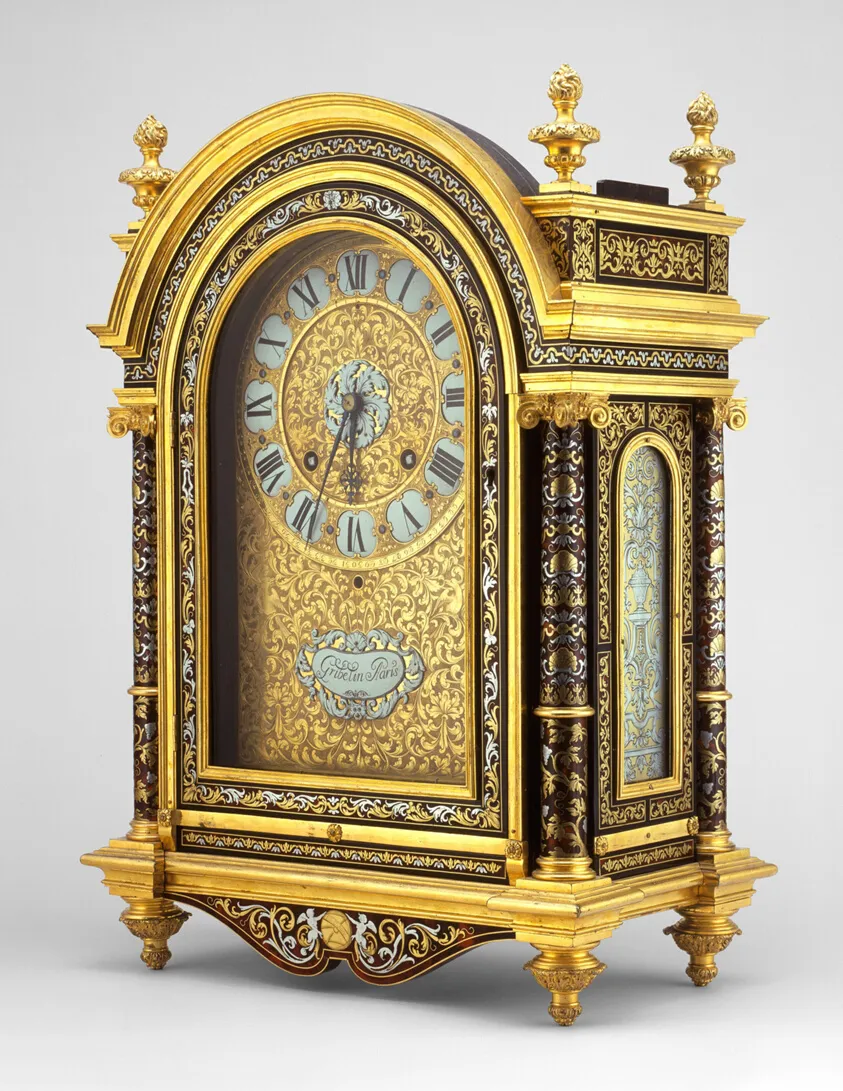
Table clock, about 1675. Clocks are where the 'marriage' is most common and hardest to see: the case can be period and the movement sixty years younger. You ask, and you ask for it in writing.
Table ClockAndré Charles Boullec. 1675 · Art Institute of Chicago · obra 156887 · CC0
Three · Is it by whom it claims?
The expensive question. It is almost never settled by looking at the object, and anyone who tells you otherwise is selling you something. It is settled with paperwork — but before paperwork, with vocabulary, because the catalogue is already telling you the truth:
- Zurbarán — the house asserts authorship and answers for it.
- Attributed to — a reasoned opinion, not proven.
- Workshop of — his workshop, not his hand.
- Circle of — someone in his immediate circle.
- School of / follower of — his manner, another hand, sometimes another century.
- In the style of — says nothing about date or author.
Each rung divides the price, and none of them is a deception: they are honest formulas the trade has used precisely for a century. The deception is charging one rung as if it were the one above, or saying “it’s a Zurbarán” out loud and writing “school of” on the invoice. When that happens, the written version is what counts: it is the only one that exists the next day.
Four · Can it be sold?
The question almost nobody asks, and the only one that can leave you without the piece and without the money while being right about everything else.
An antique can be perfectly genuine and not belong to the person selling it. Two rules worth knowing before you pay, set out in sixteen years do not launder a stolen piece: anyone unlawfully deprived of a movable object can reclaim it from whoever holds it —and good faith gives the holder the right to be repaid the price, not to keep the piece— and for protected ecclesiastical property the clock does not run at all: those goods are imprescriptible.
What you ask for, and it costs nothing:
- The chain of provenance in writing. Not “from a private collection”: from whom, when, on what document. An absence of paperwork proves nothing bad —a great deal of legitimate material circulates without an archive— but it changes who carries the risk, and that should show in the price.
- Whether the piece is listed. It is a normal question at a professional house, and the answer governs what can be done with the object afterwards.
- Be wary of sacred art with no history. It is the most stolen category. If a sixteenth-century saint turns up and nobody says which church it left, that is the question, not an impertinence.
The paperwork, in order of value
An invoice with a description. Author or workshop if there is one, period, materials, dimensions and the restorations. It is the most important document of all, because it is the only one that turns what you were told into something enforceable.
A report from an independent expert. With a name, qualifications and a date. That is what actually attests.
The certificate of authenticity. Worth what its signatory is worth. Issued by the seller it is a declaration, not a guarantee; and a stamp with no name is nothing at all.
The technical report. When a laboratory is needed: ultraviolet fluorescence shows retouching, infrared reflectography the underdrawing, radiography the internal structure, and elemental analysis the composition. That last one closes whole arguments: titanium white in a painting “from the eighteenth century” settles it, because the pigment was not on the market until the 1920s. Dendrochronology dates the wood, which is not the same as dating the furniture: it says when the tree was felled, not when the piece was made.
And the clause that sums up everything above: what happens if an independent expert contradicts what the invoice says? A serious house has the answer ready and it is usually reasonable. Discomfort at that question is, on its own, all the information you need.
The signals that arrive before the evidence
- A price far below what the same thing fetches elsewhere.
- Haste: “there’s another buyer this afternoon”.
- “It comes from an important house”, without naming it.
- An invoice with no description, or just a receipt.
- A restoration that shows up when you look at the back and that nobody mentioned.
- A large, immediate discount. It says more about the piece than about the seller.
The order worth looking in
- Turn the object over. The back, the underside and the inside of a drawer are the parts nobody fakes carefully.
- Check the material before the signature. It is cheaper and rules out more.
- Read the label and the invoice with the vocabulary in hand.
- Ask for provenance in writing.
- Decide whether the price justifies a report: if it is ten times the cost of the analysis, the analysis is cheap.
What you are actually buying
None of these checks gives absolute certainty, and anyone promising otherwise is selling reassurance, not information. What they do is move the risk: out of a conversation that gets forgotten and into a document that can be produced.
Which is why the last check is not about the object but about who is selling it. A house that documents what it holds, writes down what it knows and admits what it does not will answer for a piece for years. The rules we ask of the houses listed here are in the pact, dated; and who you are dealing with is what the directories of antique dealers and galleries are for.