How to tell if a painting is original
What you can check with light, a loupe and ten minutes, and what needs a laboratory. The difference between original, copy and reproduction.
Reviewed on
«Original» does not mean the same thing to everyone, and that is the first trap. Before asking whether a painting is original it is worth knowing exactly what is being asked, because there are three different questions hidden inside one:
- Is it paint, or a printed reproduction? You can settle this yourself, today, in two minutes.
- Is it from the period claimed? This can be narrowed down considerably by looking at the support and at how it has aged.
- Is it by the hand claimed? This is almost never settled without documentation and an expert, and anyone who tells you otherwise is selling you something.
Let us take them in order, because ninety per cent of the trouble is avoided at the first.
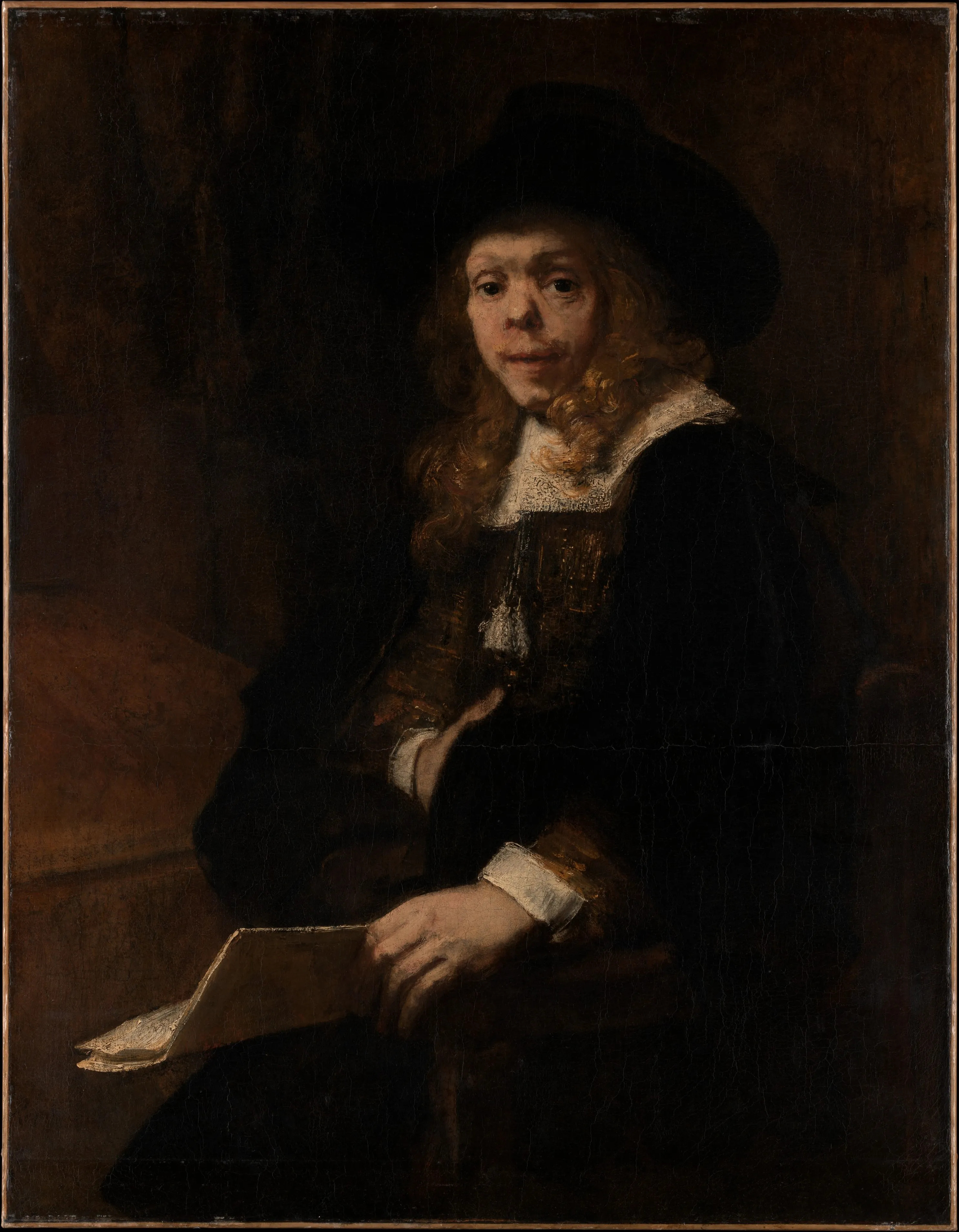
Rembrandt, circa 1665. The loaded brushwork of the late period is material with volume: light crosses it and casts a shadow. No print reproduces that, however good, because a print is flat.
Portrait of Gerard de LairesseRembrandt (Rembrandt van Rijn)1665–67 · The Met · objeto 459082 · CC0
One · Is it paint, or a print?
The easiest check and the one that saves the most money. A painting is matter deposited on a surface; a reproduction is flat ink.
Look at it obliquely. Stand to one side and find a light source falling almost parallel to the canvas. Genuine paint reveals the relief of the brushwork: impasto catches the light and casts its own shadow. A print is as smooth as a photograph, however much varnish has been poured over it.
Use the loupe. Ten magnifications is enough. If you see a regular grid of dots —aligned rows, often in cyan, magenta, yellow and black— it is offset printing. There is no exception to this rule: only a machine produces that grid.
Look at the edge of the stretcher. In an oil on canvas the paint usually runs slightly over the edges when the canvas is mounted, and there you can see the thickness of the layer. In a print laid on board or canvas, the edge is clean and the material changes abruptly.
Beware the hybrid. There are printed reproductions with brushstrokes of varnish or clear paste added to simulate relief. They give themselves away because the relief does not coincide with the image: the shine is in places where the picture has no impasto.
Two · Is it from the period claimed?
Here there are no certainties, but there are indications that accumulate.
The support. A seventeenth-century canvas is linen, of irregular weave and woven on a hand loom: hold the reverse up to the light. Industrial cotton of uniform, perfectly regular weave is nineteenth century onwards. In panel, a hand-sawn board has irregular marks; one cut with a circular saw is not earlier than the mid-nineteenth century.
The stretcher. Stretchers with keys in the corners —those small wooden wedges for tensioning— become general at the end of the eighteenth century. A painting declared to be sixteenth century on a keyed stretcher has been relined at the very least; that is not a bad thing, but you need to know it.
The nails. Hand-forged ones, with an irregular head, are earlier than about 1800. Metal staples are twentieth century.
The craquelure. It exists in any old painting, but what matters is not that it exists —it can be induced— but that it is coherent: tighter at the edges and near the tacks, following the grain if it is a panel, different in the impasto than in the thin areas. Craquelure that is uniform across the whole surface is suspect precisely because it is too orderly.
The reverse. It is the part nobody fakes carefully, and for that reason the most informative: exhibition labels, customs stamps, gallery marks, inventory numbers, the dirt accumulated on the crossbars. A back that is too clean on a three-hundred-year-old painting says as much as a dirty one.
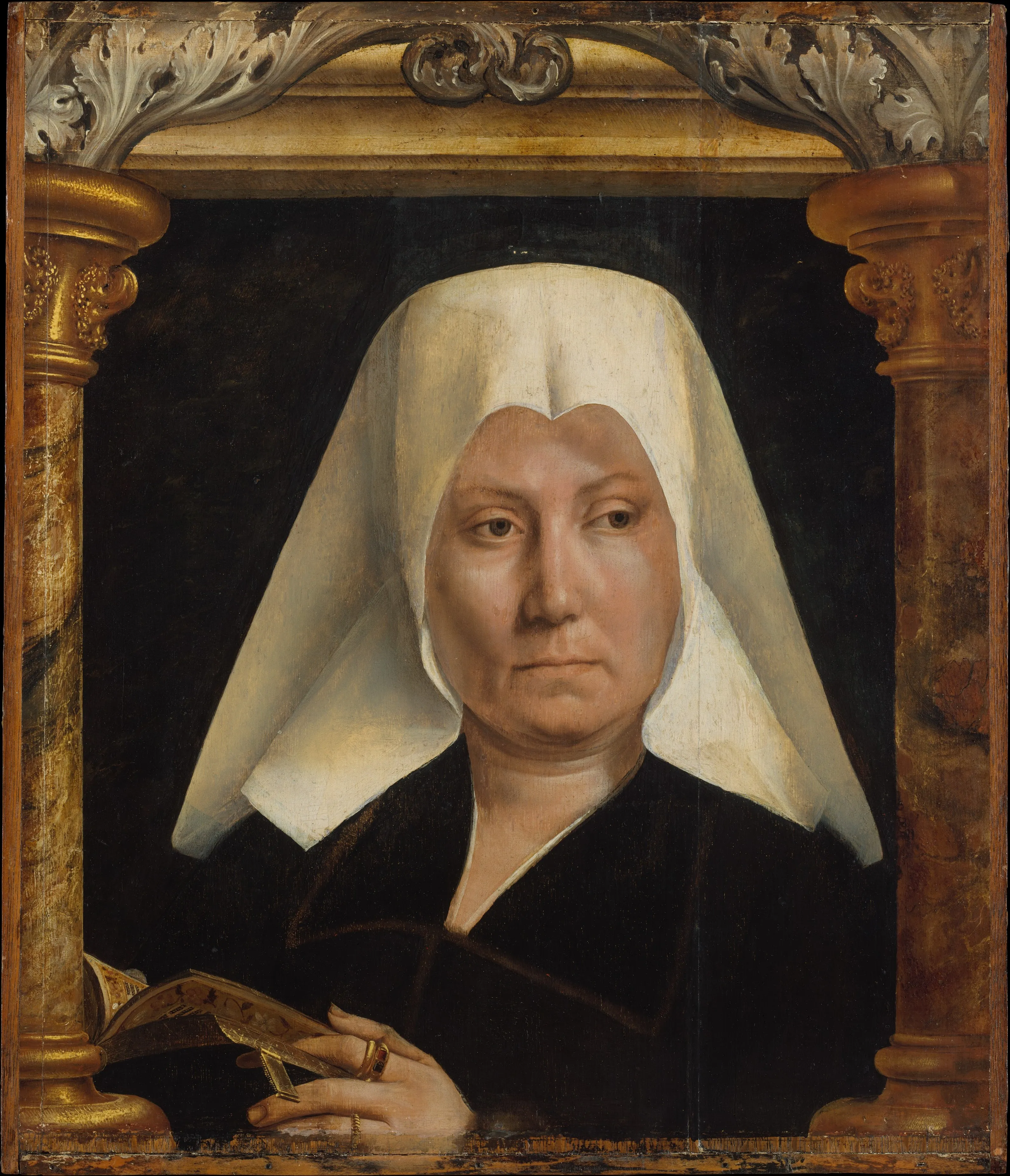
Flemish panel, circa 1520. In work of this period the flesh is built up with transparent glazes over a white ground; any modern overpaint is detected because it cannot reach that depth and stays opaque.
Portrait of a WomanQuinten Massysca. 1520 · The Met · objeto 436986 · CC0
Three · Is it by who they say?
This is the expensive question, and the honest answer is that it is almost never settled by looking at the painting. It is settled with paperwork: documented provenance, catalogue raisonné, a report from an expert independent of the seller.
One check you can make here and now: with a loupe, look at whether the signature cracks along with the craquelure or is painted on top of the cracks. The second means it was added after the painting aged.
The rest —what documentation to ask for, what each attribution formula means exactly and how it affects the price— is set out in the old master painting buying guide, which is where it belongs: here we are settling whether what is in front of you is paint, not what it should cost.
What you can do in ten minutes, in short
- Look obliquely for the relief of brushwork.
- Run the loupe over an area of flat colour looking for a dot grid.
- Look at the reverse: canvas, stretcher, nails, labels.
- Check whether the signature cracks with the craquelure or sits on top.
- With a cheap ultraviolet torch: recent overpaint appears as dark patches against the greenish fluorescence of old varnish.
That much rules out reproductions, detects large interventions, and tells you whether what is in front of you deserves a report.
And what you cannot do
Date it precisely, identify pigments, read the underdrawing or assert an authorship. That is laboratory and expert work, and it costs money — but far less than getting a purchase of any size wrong.
The practical rule: if the price is of the same order as a technical report, save yourself the report and buy for pleasure. If it is ten times more, the report is cheap.
And the question that settles the conversation with the seller: «what happens if an independent expert contradicts the attribution?» A serious professional already has an answer ready, and it is usually reasonable. Discomfort at that question is, in itself, all the information you need.
That question, and the rest of the ones worth asking before paying for any period piece —not only a painting— are gathered in how to tell whether an antique is genuine.