There are two ways to lose money buying old master paintings. The first is to pay for a Rembrandt and take home an anonymous eighteenth-century follower. The second, far more common and hardly ever discussed, is to pay for a genuine work a price that would only make sense if it were in a different state of conservation.
This guide is about the second, because the first is settled by an expert and the second you have to see for yourself.
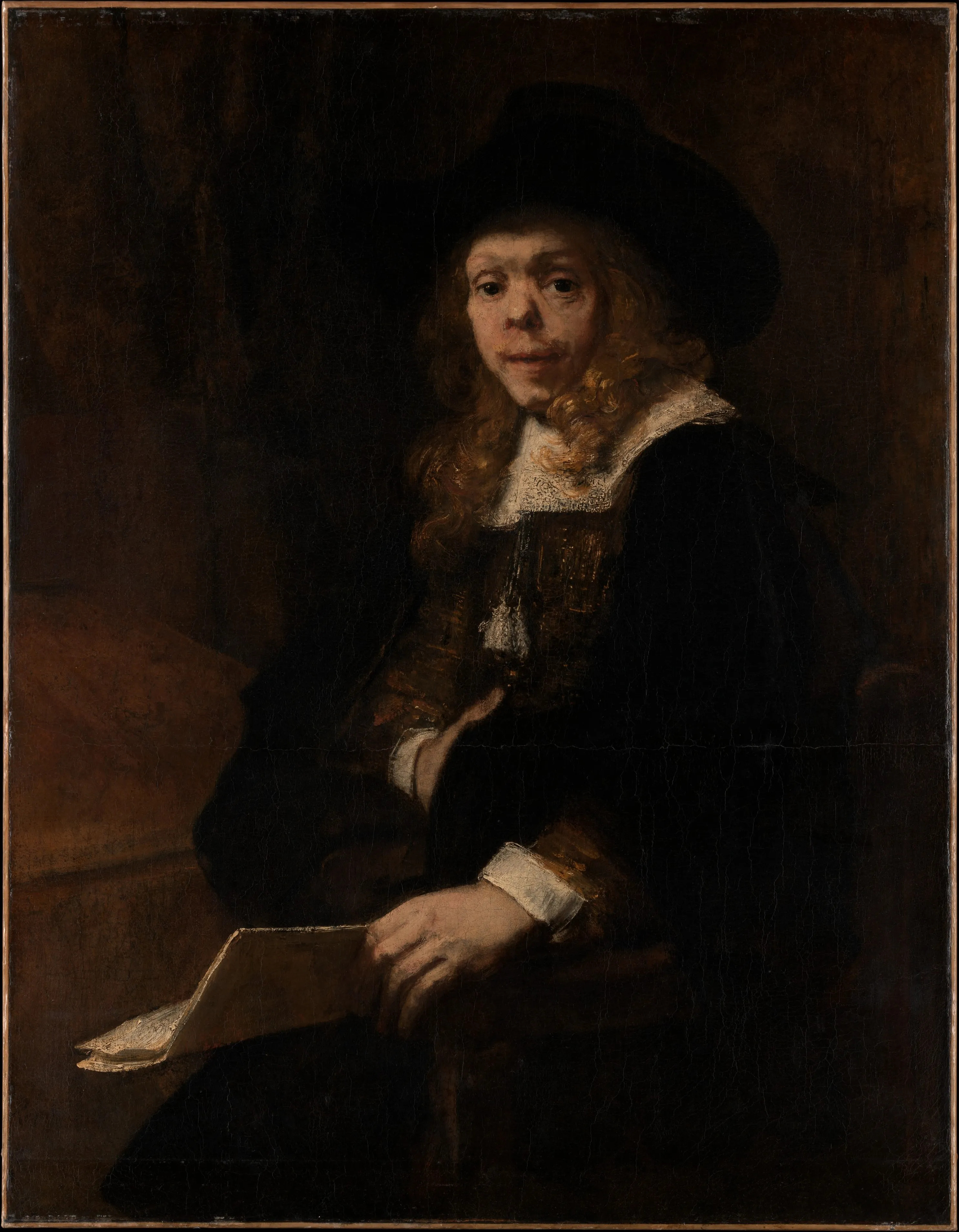
A state portrait by the late Rembrandt: loaded brushwork, neutral ground and all the information concentrated in the face and hands. It is exactly the kind of work on which disputed attributions are built.
Portrait of Gerard de LairesseRembrandt (Rembrandt van Rijn)1665–67 · The Met · objeto 459082 · CC0
The first thing is not the painting, it is the support
Before looking at what is painted, look at what it is painted on. The support conditions everything else: how the paint ages, what pathologies it can have and what interventions it will have undergone.
Panel. Dominant until well into the sixteenth century in Flanders and Italy. It is rigid, so the craquelure follows the grain of the wood and opens in more or less parallel lines. Its problems are warping —the panel curves— and insect damage: look at the edges and the reverse for the galleries insects leave. Batten reinforcement on the back is normal in an old panel; what to ask is when it was put there.
Canvas. It takes over from the sixteenth century and is standard from the seventeenth onwards. It is elastic, so its craquelure forms a more irregular network, with knots and changes of direction. Its classic pathology is loss of tension and, with it, relining.
Copper. Uncommon and very revealing. It was used above all in small format between the sixteenth and eighteenth centuries, for high-quality cabinet pictures. On copper there is almost no craquelure, the surface has a bright enamel quality, and losses come from flakes lifting rather than from cracks. If you are shown a copper with a network of craquelure, something does not add up.

Flemish panel, early sixteenth century. The landscape swallowing the religious scene is a mark of Patinir, and the rigidity of the support explains why its craquelure arranges itself in lines rather than a net.
The Penitence of Saint JeromeJoachim Patinirca. 1515 · The Met · objeto 437261 · CC0
Craquelure, and why its mere existence is not enough
It is the detail everyone looks at and almost nobody knows how to read. That a painting has craquelure says nothing: it can be induced with heat, with forced drying, or simply by painting over a badly cured ground. It has been done for two centuries.
What cannot easily be faked is its coherence. Genuine craquelure obeys physical forces, and therefore behaves differently in each area of the painting:
- It tightens near the edges and the stretcher tacks, where tension is greatest.
- It runs around the knots in a panel and follows the grain.
- It is coarser in areas of impasto, where there is more material, and finer in the glazes.
- It changes as it passes from one layer to another: the sky and the flesh tones of the same painting do not crack alike.
Craquelure that is regular, of the same gauge across the whole surface and indifferent to what lies beneath, is the single most useful warning sign you can learn to see without instruments.
Look at the work in raking light, then under ultraviolet
Raking light. Ask to see the painting with a light almost parallel to the surface, from one side. It is a request any professional understands, and it reveals what frontal light hides: deformations of the support, patches on the back, differences in texture between original paint and overpaint, and the real relief of the brushwork.
Ultraviolet. A pocket UV torch costs little and changes the conversation. Old varnish gives off an even greenish fluorescence; recent overpaint appears as dark patches that do not fluoresce. It is not conclusive proof —overpaint from eighty years ago already fluoresces— but it will tell you in thirty seconds whether the painting has been worked on in the last half century, and where.
Neither of these makes anyone an expert. They serve a different purpose: knowing what to ask.
If the doubt is more basic —whether what is in front of you is paint at all or a printed reproduction— that is settled in two minutes and is explained separately in how to tell if a painting is original.
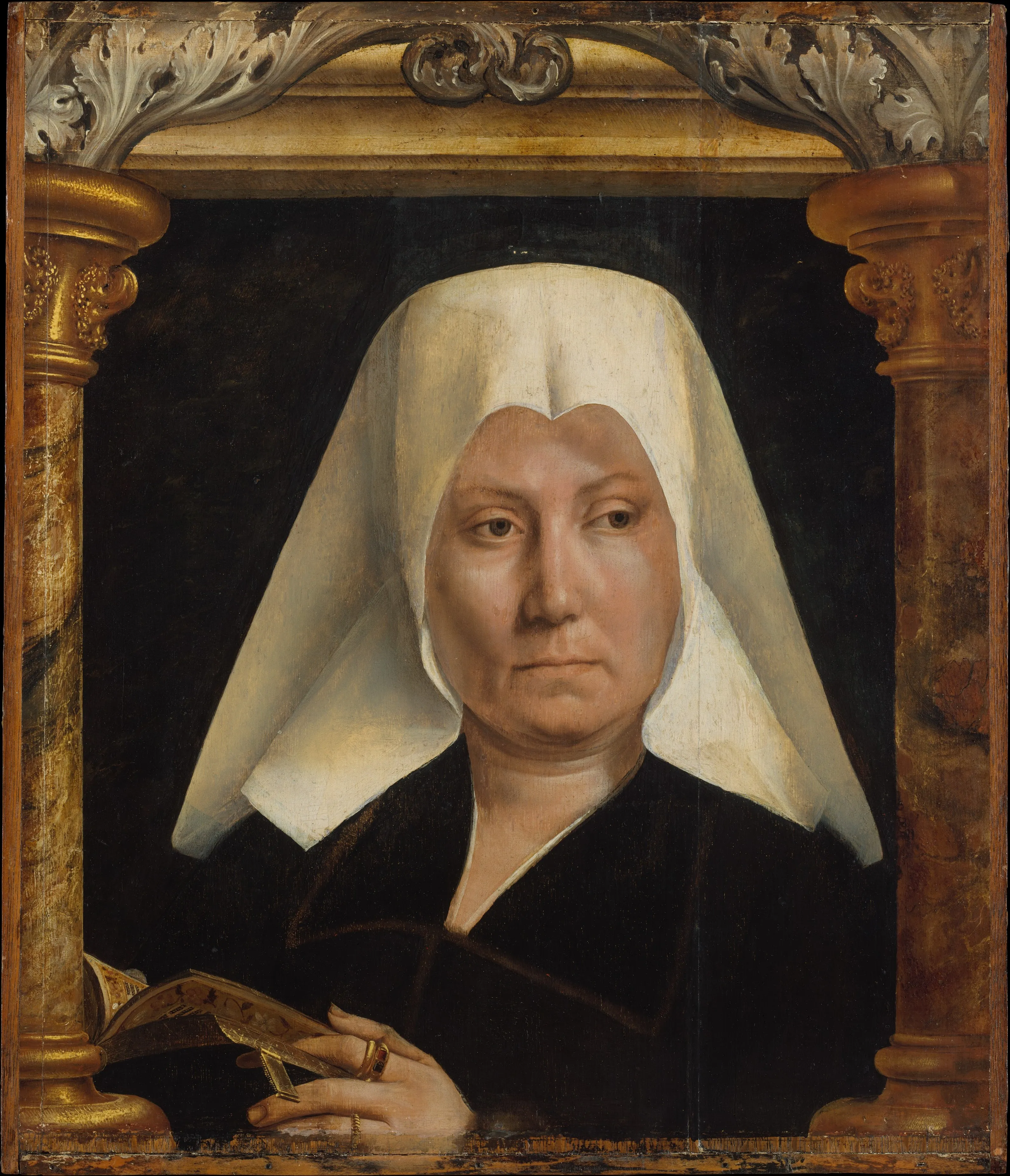
Flemish portrait, circa 1520. In work of this period the flesh is built from the finest glazes over a white ground: any overpaint on the face is detected immediately, because it cannot achieve that transparency.
Portrait of a WomanQuinten Massysca. 1520 · The Met · objeto 436986 · CC0
Restored is not the same as ruined
There is an expensive misunderstanding here. A four-hundred-year-old painting has been worked on, almost certainly more than once. The opposite would be rare and suspicious. The right question is not «has it been restored?» but «how much, where and by whom?».
What counts as normal and carries no penalty if declared:
- Relining, when the original canvas has lost strength.
- Cleaning of oxidised varnish, which yellows over time.
- Filling and retouching of small losses, if the retouching is recognisable close up and discreet from a distance.
What does take value away, and a great deal of it:
- Extensive overpaint across surviving original paint, rather than confined to the losses.
- Abrasive cleaning that has taken off the final glazes. It is irreversible and is often recognisable because the painting looks «raw», with hard contrasts and no atmosphere.
- Badly executed wax-resin relining, which flattens the texture of the brushwork. It shows in raking light: the surface is as flat as a print.
A restoration report with before-and-after photographs is worth real money. Ask for it. If none exists, ask who worked on it and when; a serious house knows.
The signature is the least reliable thing on the painting
It is hard to believe, but so it is: the signature is the easiest thing to add and therefore the thing that proves least. Before the seventeenth century signing was not the norm, and there are more spurious signatures added in the nineteenth —when collecting by name came into fashion— than there are doubtful originals.
What does prove authorship, in order of weight:
- Provenance documentation: old invoices, inventories, exhibition catalogues, period photographs showing the work hanging.
- Publication in the artist’s catalogue raisonné, where one exists.
- A report from an expert independent of the seller. Independent is the word that matters.
- Technical analysis: infrared reflectography to see the underdrawing, X-radiography for the lower layers.
And a practical warning: a signature that sits on top of the craquelure, rather than cracking along with it, was added after the painting aged. A ten-power loupe shows it.
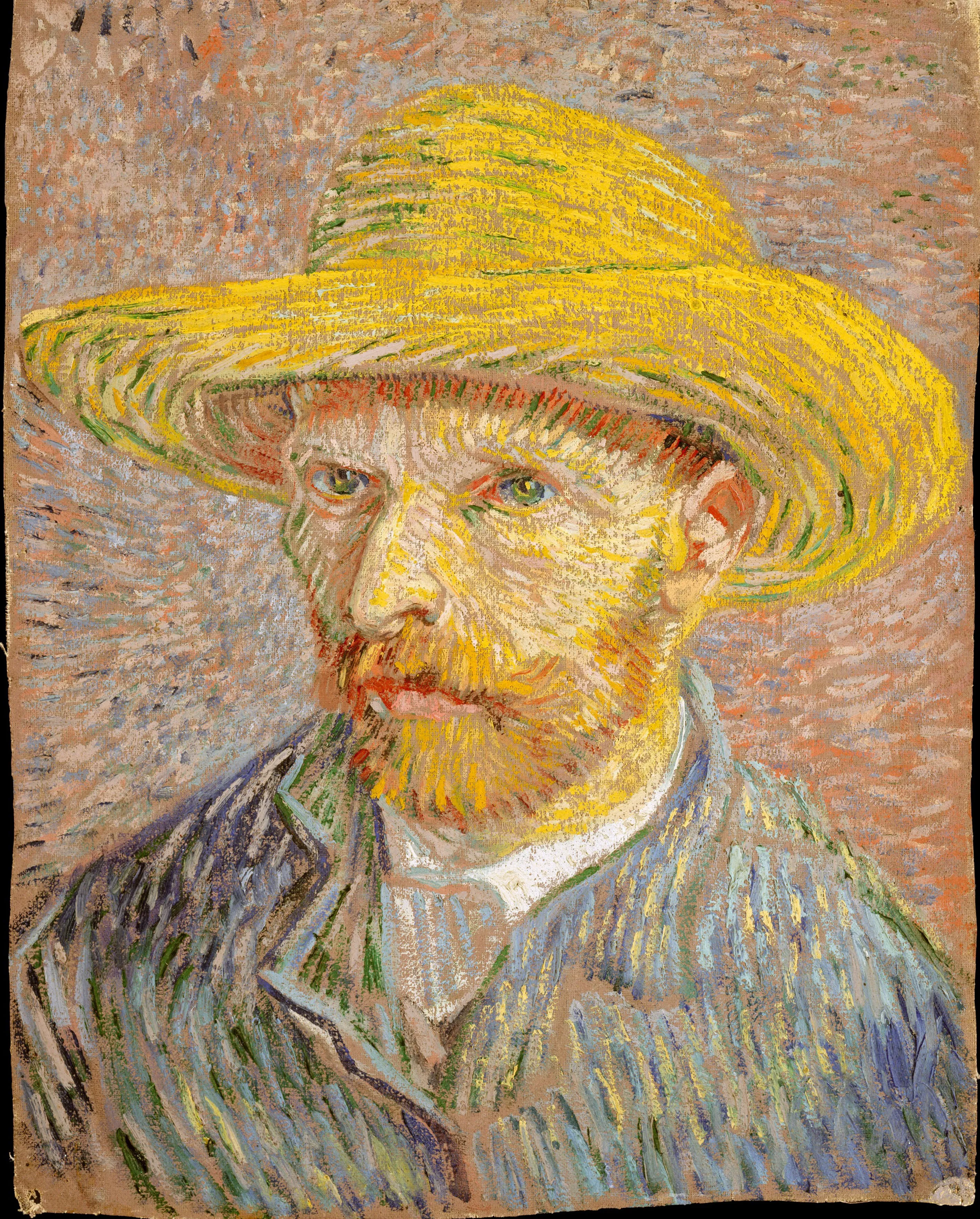
Van Gogh, 1887. A case where the brushwork is so recognisable that it functions as a signature; but even here, what holds the price in the market is the catalogue raisonné and the chain of owners, not the stroke.
Self-Portrait with a Straw Hat (obverse: The Potato Peeler)Vincent van Gogh1887 · The Met · objeto 436532 · CC0
Provenance: what really moves the price
Between two works of similar quality, the one with documented provenance can be worth several times more. And not out of snobbery: provenance answers at once the question of authenticity and the question of good title.
Almost no chain is complete, and that is normal. What marks out a serious seller is not having an impeccable provenance but declaring the gaps. «From a private Madrid collection since the nineteen-sixties, no earlier documentation» is an honest and usable sentence. «From an important European collection», with nothing more, is a sentence that says nothing and is used precisely in order to say nothing.
Check as well that the piece does not appear in the stolen art databases. It is free and takes minutes, and a claimed work cannot be sold or insured however much you bought it in good faith.
What is actually paid in the Spanish market
The quality of a work and its price resemble each other less than they should. Four factors move the figure regardless of how good the painting is, and it is worth knowing them before negotiating.
The subject. It counts for more than the signature in the middle of the market. Landscape and marine sell themselves; still life does well; the portrait of an unknown sitter does badly, however good it is — nobody wants to hang a man they have never met. And religious painting is the extreme case: work of the very first quality at prices that bear no relation to its merit, because the domestic market rejects it. If you are buying for pleasure and not as an investment, that is the best art per euro in Spain today.
Size. There is a commercial band, roughly between 60 × 80 and 100 × 130 centimetres, that sells far better than anything else. Below it a work loses presence; above it, the number of houses where it fits shrinks drastically. A three-metre altarpiece can cost less than a small panel of equivalent quality, and the reason is purely logistical.
The school. In Spain, Spanish work is well paid —Madrid, Seville, Valencia, the nineteenth-century Catalan school— and so are Flemish and Italian, which have been in collections here for centuries. Central European and Nordic work of the nineteenth century, by contrast, sits systematically below its price in its country of origin. It is a real asymmetry, and one you can use.
Condition. It has been said already, but it is worth putting a number on it: between an intact work and the same work with twenty per cent overpaint there can be a difference of fifty per cent or more. Condition weighs more than almost any other variable except firm authorship.
One practical consequence of all this: a well-preserved work, on a rewarding subject and at drawing-room size, by a secondary artist, is usually a better buy than a doubtful work by a great name. The first can be resold; the second stays in the house for ever.
What to ask, word for word
Take it in writing. A serious professional answers all seven without discomfort, and discomfort at any of them is already an answer:
- What attribution wording will appear on the invoice: «by», «attributed to», «school of», «circle of» or «follower of»?
- What is the support, and has it been relined or transferred?
- What restoration has it had, and when? Is there a report?
- Roughly what percentage of the surface is overpaint?
- What provenance documentation comes with the work?
- Is the frame the original one for the piece?
- What happens if an independent expert contradicts the attribution? Within what period and on what terms is a return accepted?
The seventh is the one that separates a professional from a seller. Do not skip it.
And the price
There is no price list. What there is are checkable references: auction results for comparable work, which are prices paid and not prices asked. That is the difference between what something is worth and what somebody wants for it.
Look for pieces by the same artist or circle, of similar size and quality, sold in the last three or four years. If the price you are quoted departs sharply upwards, ask why —sometimes there is a good reason: better condition, better provenance, a more commercial size—. If it departs sharply downwards, ask as well. Bargains in old master painting almost always have a name, and that name is usually «an attribution that does not hold».