Antique, vintage or retro
The three words are used as synonyms and they are not. Which one is chosen changes the price, what you can demand of the seller and the export paperwork.
Reviewed on
The three words are used as though they meant the same thing, and they do not. The confusion is not innocent: on a label, the word chosen changes the price, and more often than not it is chosen by someone who knows exactly what they are doing.
Here is what each one means, how to check it without taking the seller’s word, and what getting it wrong costs.
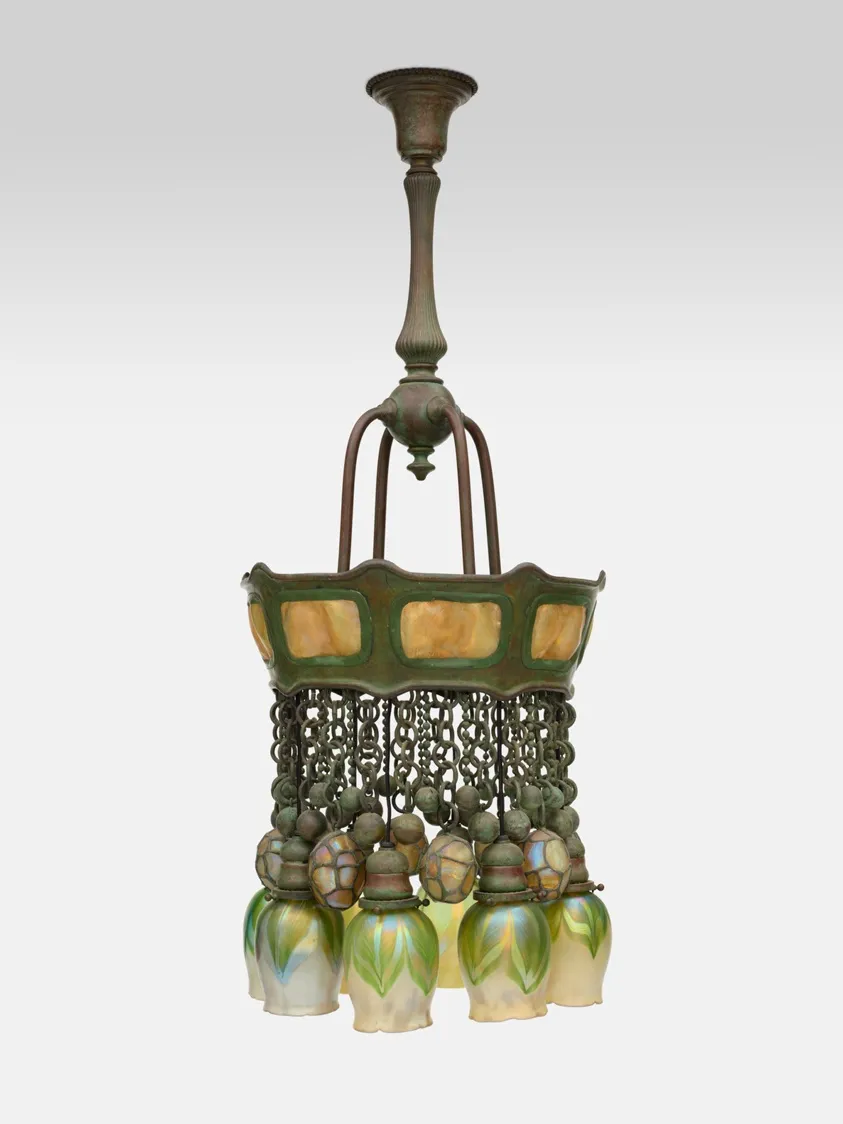
Tiffany Studios lamp, circa 1900. It has just crossed the hundred-year line and is, technically, an antique — though nobody would describe it as «antique-looking». It is the best reminder that we are talking about a date, not a style.
Turtleback Moorish ChandelierTiffany Studios (Firm)c. 1900 · Art Institute of Chicago · obra 260451 · CC0
Antique: more than a hundred years old
By commercial convention, a piece more than a hundred years old. This is not a poetic criterion or an opinion: it is the one customs use to separate one tariff heading from another, and from there it passed into the language of the trade. In 2026, that means before 1926.
It is a moving line, and it is worth keeping in mind: every year that passes, a whole vintage of objects crosses to the other side. What is late vintage today will be antique within a decade, without the piece having changed at all.
And a warning that saves grief: being old does not make something valuable. A production sideboard from 1910, machine-made by the thousand, is an antique and is worth less than a 1955 design chair. Antiquity is a condition of date; value comes from quality, rarity, condition and documentation.
Vintage: between twenty and a hundred years, and representative
This is the most abused of the three. «Vintage» demands two things, and almost always only the first is mentioned:
- An age of roughly between twenty and a hundred years.
- That the piece be representative of its period.
The second is what does the work. An anonymous lamp from 1970, mass-produced and with no recognisable characteristic, is not vintage: it is an old lamp. A Castiglioni Arco from 1970 is, because it embodies a moment in design that somebody may want specifically.
Put another way: every vintage piece is old, but most old things are not vintage. The word promises membership of a movement, not merely having survived.
Retro: new, in disguise
Made today, imitating the aesthetic of another period. It has no age at all: zero years.
There is nothing wrong with buying retro if you know what you are buying — a new piece of fifties-inspired furniture can be an excellent purchase. The problem is that «retro» is the word that appears when somebody wants you to associate their product with a market it does not belong to, and it usually arrives alongside «style», «type» or «inspired by», which are the three tics worth learning to spot.
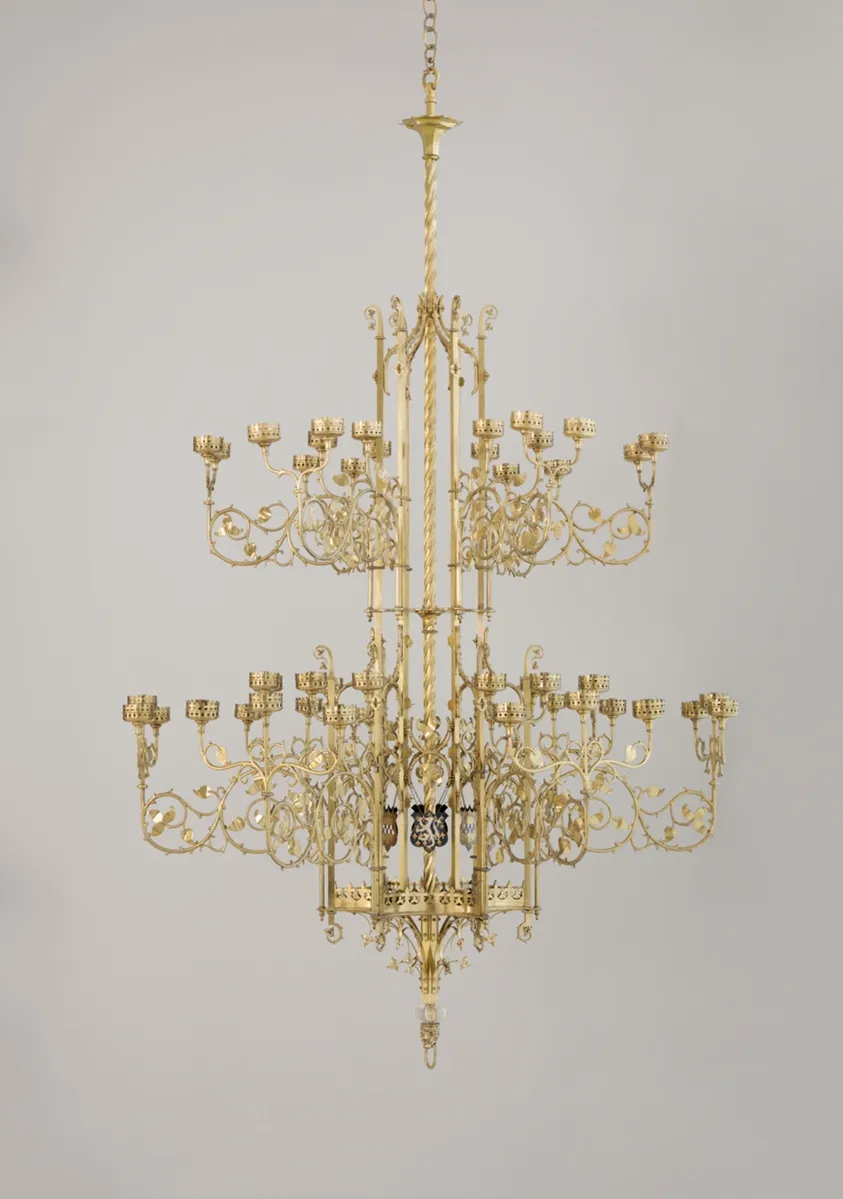
Pugin chandelier, 1852. Half a century earlier than the Tiffany above and from a completely different world: both are antiques. The only feature they share is having turned a hundred.
ChandelierAugustus Welby Northmore Pugin1852 · Art Institute of Chicago · obra 205221 · CC0
How to date a piece without trusting the label
In furniture, where most is at stake, there are physical signals that are hard to fake and easy to look at. None is conclusive on its own; together they give a fairly narrow bracket.
The screws. Before 1850, handmade: the thread is irregular, the tip is blunt and the slot in the head is off centre. Afterwards, industrial and perfectly regular. The sharp point appears around 1850 and the cross-head screw does not arrive until well into the twentieth century.
The saw marks. Look at a surface that was never finished: the bottom of a drawer, the back. A handsaw leaves irregular, slightly oblique strokes; a circular saw leaves concentric arcs, which appear in the mid-nineteenth century; a band saw leaves straight parallel lines, from the last third of it.
The dovetails. Cut by hand they are few, uneven and irregularly spaced. Machine-cut —from the late nineteenth century— they are identical, evenly spaced and all the same size. It is among the most reliable indications there is.
The thickness of the veneer. Saw-cut veneer, until the mid-nineteenth century, is between one and three millimetres. Knife-cut veneer, later, drops below a millimetre and is visibly finer at the edges.
The wear. It has to be where hands and feet touch: drawer edges, around the lock, armrests, low stretchers. Wear spread evenly over the whole piece, or in places where nobody rests anything, was made with sandpaper.
The measurements. If the dimensions come out round in inches rather than centimetres, it points to Anglo-Saxon manufacture or to a date before the metric system took hold. It is a minor indication but it adds up.
What changes in practice
This is not an argument about vocabulary. The label decides three concrete things:
What you can demand. Of an antique you ask for provenance and documented condition. Of a vintage piece, authorship and model — it is a market of names and catalogues. Of a retro piece, the guarantee of a new product, an invoice and a returns period, like any shop furniture.
How it is restored. And here the difference is enormous. On an antique, an aggressive restoration destroys value: patina cannot be put back. On a vintage design piece, by contrast, returning it to factory condition often recovers value — a sixties armchair reupholstered in the correct fabric is worth more than one with its original upholstery in ruins. The same work, opposite results.
The paperwork. The hundred-year line is not only commercial. Cultural goods above a certain age and value may need administrative authorisation to leave Spain, and the customs classification of an antique is not that of used furniture. If the purchase is of any size, or an export is involved, ask before paying: it is a procedure that can be resolved, but not on the spot.
The signal that saves time
If a listing says «vintage» and the piece is a hundred and twenty years old, there are two possibilities: either the seller does not know what they have, or they would rather you did not know either. Both are reason enough to ask more.
And it works the other way. Someone who tells you «this is not an antique, it is from 1960, though you will see it labelled that way elsewhere» is showing you something they could have kept quiet. That sentence is worth more than any certificate.
And if the doubt is not about age but about authenticity —the material, the authorship, the provenance— those are three separate questions, and they are in how to tell whether an antique is genuine.