Furniture is the largest category in the trade by volume: the most bought and the most varied, from a seventeenth-century coffer to an Art Nouveau display cabinet. It is also where price depends least on age and most on two things almost nobody checks before negotiating: size and the state of the surface.
This guide is about what there is, what it costs and what to ask. To check whether a piece is from the period claimed, there is the tool on dating by marks of manufacture, which is meant to be consulted with the piece in front of you.
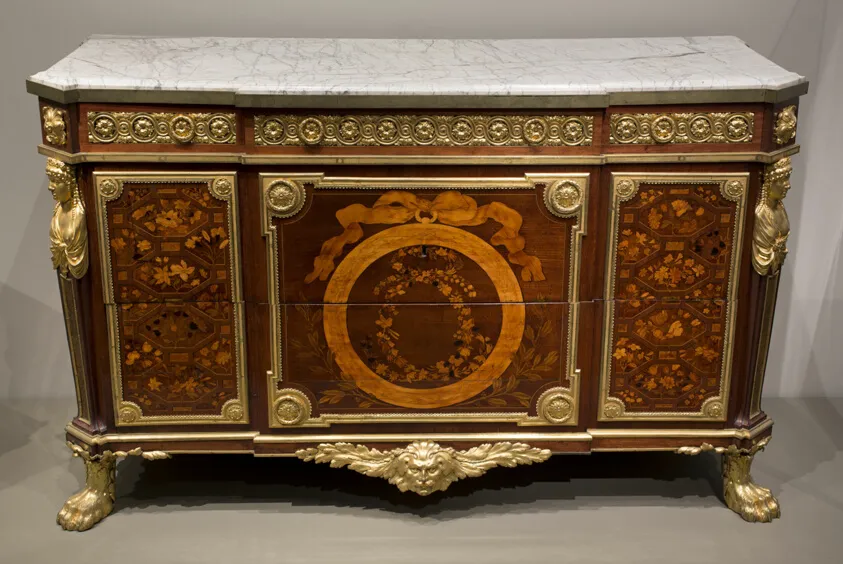
Chest of drawers by Jean-Henri Riesener, circa 1770. Cabinetmaking of the royal kind: marquetry, mercury-gilded bronzes and a construction meant to last centuries. The benchmark everything else is measured against.
Chest of Drawers (Commode)Jean Henri Riesener1770–80 · Art Institute of Chicago · obra 109412 · CC0
What types there are, and what each one asks of you
Chests of drawers. The most sought-after piece in the category, for a practical reason: it is the width of an ordinary stretch of wall and it has an obvious use. That holds its price even when the rest of the furniture market falls. Check that the drawers run without forcing, and whether it keeps its original bronzes.
Sideboards. The opposite case. They are magnificent and enormous, and they do not fit in a modern flat. They sell well below their quality, so if you have a dining room this is where the most good furniture is bought for the least money.
Desks and bargueños. The Spanish speciality above all others. The bargueño —fall front, interior drawers on show, on a stand or low chest— is a form particular to the sixteenth and seventeenth centuries with no exact equivalent elsewhere. Here it matters a great deal that the stand is its own: it is common to find good upper sections on remade stands, and that has to be said.
Display cabinets. Take particular care with these. It is the form with the most «conversions»: three-section wardrobes split into two cabinets, or solid doors replaced with glass. Neither is illegitimate if declared, but it changes the value considerably. Always ask, and ask in those terms.
Coffers and chests. The oldest form of storage furniture, and the one that best preserves the marks of use. They tend to be good value because their original function no longer exists.
Sets of chairs. Here the whole is worth more than the sum: six matching chairs fetch considerably more than six times one loose chair. If you are offered four from a set of six, that is a different price.
Tables. The large ones, very cheap for the same reason as sideboards. Medium and occasional tables hold their price well.
Period or style
This is the distinction that moves the most money in this category.
Period means made in the period declared. In the style of —Isabelline, Louis XV, Empire— means made later in imitation of that form. The second description is perfectly honest, and there are excellent style pieces from the nineteenth and twentieth centuries with good cabinetmaking behind them. What is not honest is charging for one as if it were the other.
That the exact wording appears in writing on the invoice is not distrust: it is normal, and a serious house puts it there without being asked.
To understand which taste each name refers to —and why the nineteenth century remade all the earlier ones— there is the guide to Spanish furniture styles.
What takes value away, and how much
This weighs more in a negotiation than age does:
| Intervention | Effect |
|---|---|
| Consolidating joints with animal glue | None. It is maintenance |
| Replacing missing veneer | Little, if well done and declared |
| Filling a loss in the carving | Little, if recognisable close up |
| Stripping | Devastating. Can be more than half |
| Sanding | Devastating and not reversible |
| Revarnishing with synthetics | A great deal |
| Changing the hardware | Considerable, and it also prevents dating |
| Converting the piece (a coffer into a table) | A great deal. It destroys the original object |
We cover it at length in the piece on how to clean antique furniture.
What to ask
- Is it period or in the style of? What will the invoice say?
- Which parts are original and which are replacements?
- Has it ever been stripped, sanded or revarnished?
- Is the hardware its own?
- Has the woodworm been treated, and when?
- Has it been converted or altered from its original form?
What is paid in the Spanish market
Size matters more here than in any other category. Large three-section wardrobes, tables for twelve and monumental sideboards are systematically cheap: they are excellent and they do not fit in a flat. If you have the room, that is the best value in the trade by a distance.
What is rising: chests of drawers and console tables —manageable size and an obvious place to put them—, chairs in sets of six or more, and any piece with marquetry or quality bronzes.
Good Spanish work is undervalued against French and English of equivalent quality. Seventeenth-century Castilian walnut, bargueños and eighteenth-century Catalan furniture sell below what a comparable French piece would fetch, and they are a market of their own.
Where to see it all in one place
Furniture is bought by looking at it from behind, from underneath and inside the drawers, and at a fair you can do that fifteen times in two hours. Feriarte is the big one in the Spanish calendar and the only one with a vetting committee; Almoneda is its spring sister and reaches into vintage. The whole calendar is in fairs.