Spanish furniture styles, reign by reign
Charles IV, Empire, Ferdinandine, Isabelline, Alfonsine and Modernista: what an antique dealer looks at to place a piece in its period.
Reviewed on
Placing a piece of furniture in its period is the first thing anyone about to buy it does, and also the first thing they get wrong. The reason is that the name of a style describes a taste, not a date: the nineteenth century remade almost every earlier style and the twentieth remade them again, so the same silhouette can belong to three moments two hundred years apart.
This page sets out the Spanish vocabulary —the words dealers here use, which have no exact equivalent in English or French— and says, for each style, what to look at. What it does not do is date: for that there are the marks of manufacture, which have their own page.
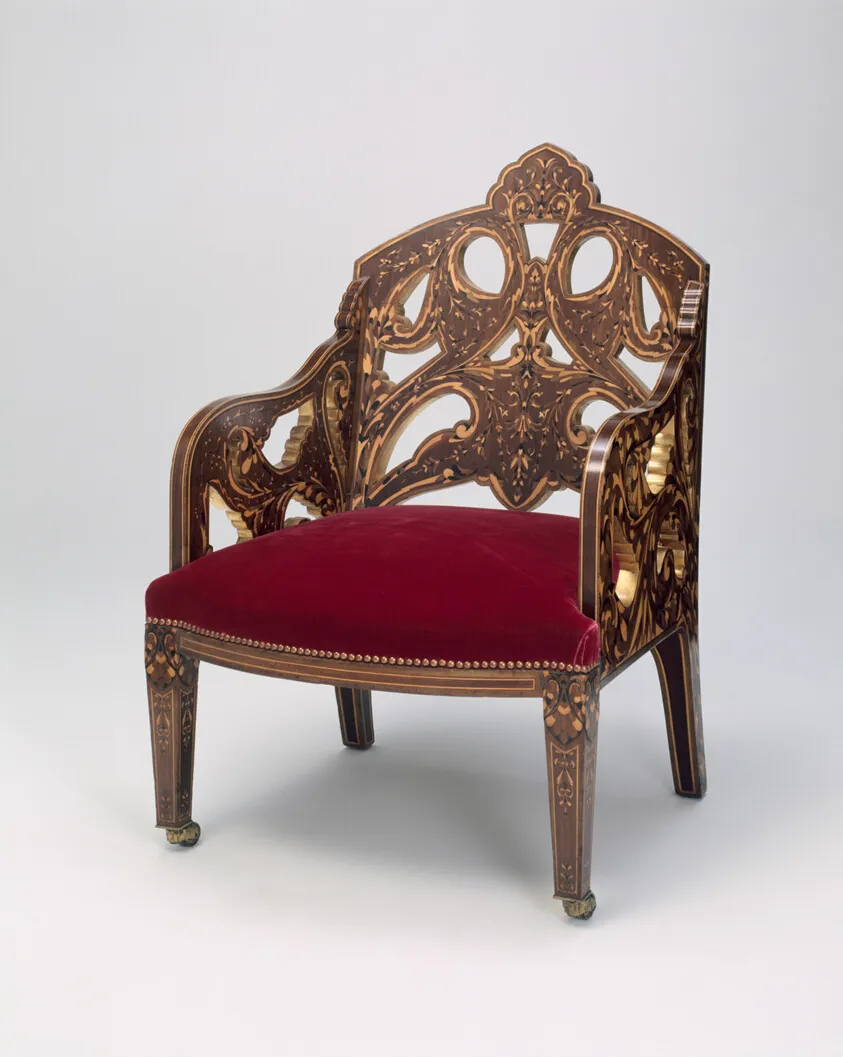
Armchair, circa 1867. It is British, not Spanish, and it is here on purpose: it shows the moment when the whole of Europe stopped inventing styles and started remaking the old ones. That turn is what in Spain we call Alfonsine, and it is the cause of almost every dating confusion of the nineteenth century.
ArmchairOwen Carter Jonesc. 1867–70 · Art Institute of Chicago · obra 146866 · CC0
Charles IV · circa 1788–1808
The last Spanish neoclassicism, contemporary with the reign that gives it its name. Straight lines, tapered fluted legs and strict symmetry. The decoration is restrained and concentrated in the marquetry and the bronzes, not in carving.
What to look at: veneer in pale woods —satinwood, citron— with contrasting stringing, and the absence of curves in the structure. When a curve does appear it is usually in the back of a chair, never in the legs.
It is the style most often confused with the Empire that follows, and the practical difference is visual weight: Charles IV is light, Empire is massive.
Empire · circa 1808–1830
It arrives with the Napoleonic occupation and outlives it. This is the style of volume: dark woods —mahogany above all—, large flat surfaces, and applied gilt-bronze mounts as the only decoration.
What to look at: the decorative repertoire, which is archaeological and recognisable —sphinxes, palmettes, swans, lyres— and legs in the form of columns or claws. Carving all but disappears: what decorates is the applied bronze.
Ferdinandine · circa 1814–1833
The Spanish, domestic version of Empire, now without the imperial apparatus. It keeps the emphatic forms but exchanges mahogany for local woods and replaces much of the bronze with gilded carving or marquetry.
What to look at: it is the style where the hand of the local workshop shows most. There is often a likeable disproportion between the ambition of the design and the means it was executed with, and that —far from subtracting— is what makes it recognisable.
Isabelline · circa 1833–1868
The most abundant in the Spanish market, and for that reason the most cited and the worst used. It is already a bourgeois style: furniture for a comfortable town house, not for a palace. Curves return, along with buttoned upholstery and dark woods, with rosewood and palisander much in evidence.
What to look at: the soft silhouette —violin or medallion backs, cabriole legs— and a taste for shine: highly polished veneers, sometimes inlaid with mother-of-pearl or brass.
A warning here: «Isabelline» is used in the trade as a catch-all for almost any dark, curved nineteenth-century piece. Whether a piece is genuinely Isabelline —made in those decades— or «in the Isabelline style» —made later in imitation— is the largest price difference on this whole list, and it has to appear in writing.
Alfonsine · circa 1874–1885
It is not a style, it is a period containing several styles at once, and it is worth knowing that before using the word. It coincides with European historicism: Gothic, Renaissance, Baroque and the Moorish are all remade at the same time, often in the same house and sometimes in the same piece.
What to look at: the mixture. A piece that quotes two different periods without disguising it is almost certainly from this moment. Also the technique: even where the form imitates the sixteenth century, the execution is industrial or semi-industrial, and that shows in the regularity of the mouldings and the joints.
Modernista · circa 1888–1915
The break with everything before. Curved lines of vegetal origin, structure and decoration fused into one thing, and woods worked into curves by steam or lamination. In Spain its centre is Catalonia, with work of exceptional quality and identifiable names.
What to look at: that the curve is structural and not applied. In historicism the curve is added on top; here the whole piece is curved. And the presence of other materials integrated from the start —glass, wrought iron, ceramic— as part of the design, not as later ornament.
What gets confused with what
| What is said | What it usually is |
|---|---|
| Isabelline | Any dark curved nineteenth-century piece, or a twentieth-century copy |
| Empire | Ferdinandine, when the wood is not mahogany and the bronzes are gilded carving |
| Spanish Renaissance | Alfonsine: nineteenth-century historicism remaking the sixteenth |
| Modernista | Art Deco, which is already the twenties and has the geometric line |
The practical rule is always the same: style is a hypothesis, manufacture is the proof. If the invoice says «Isabelline» and nothing more, it is telling you what the piece resembles, not when it was made.