Dating furniture by its marks of manufacture
Dovetails, saw marks, screws and nails: the traces a tool leaves behind, and how they let you place a piece in its period without being an expert.
Reviewed on
Furniture is the only category in the trade with an entire industry devoted to making pieces «in the style of» that look a great deal like period ones. That is why it is where mistakes are easiest.
The good news is that furniture cannot be faked entirely: it is made with tools, and tools leave marks that change over time. This page is about where to look. It is meant to be consulted with the piece in front of you, not read once.
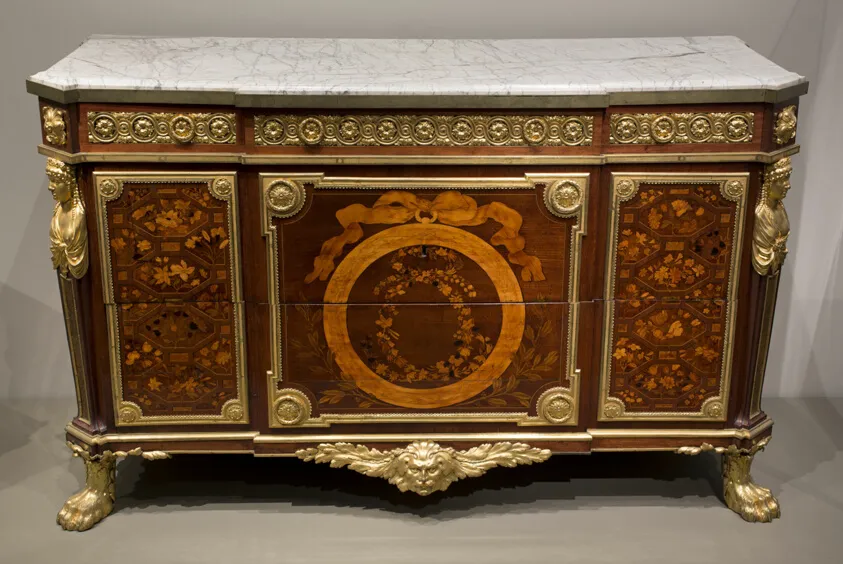
Chest of drawers by Jean-Henri Riesener, circa 1770. Cabinetmaking of the royal kind: marquetry, mercury-gilded bronzes and a construction meant to last centuries. The benchmark everything else is measured against.
Chest of Drawers (Commode)Jean Henri Riesener1770–80 · Art Institute of Chicago · obra 109412 · CC0
Start by opening a drawer
It is the single most informative thing you can do, and almost nobody does it. Take the drawer right out and turn it over.
The dovetails. The most reliable indication there is. Cut by hand they are few —two or three per joint—, uneven between themselves, and irregularly spaced. Machine-cut, from the late nineteenth century onwards, they are many, identical and perfectly equidistant. If you see twelve exactly alike, the piece is not eighteenth century however much it looks it from outside.
The bottom and the sides. Nobody ever finished the inside of a drawer, so that is where the raw wood and the tool marks are. A handsaw leaves irregular, slightly oblique strokes; a circular saw leaves concentric arcs that do not exist before the mid-nineteenth century; a band saw leaves straight parallel lines, from the last third of that century onwards.
Wear on the runners. A drawer that has been opened for a century and a half has worn its runner asymmetrically, more on the side it is pulled from. Wear that is smooth and symmetrical was made with sandpaper.
Screws and nails date a piece almost by themselves
- Before 1850: handmade screws. Irregular thread, a blunt tip —it does not bore, so a pilot hole is needed— and a slot in the head that is often off centre.
- From 1850: industrial screws, uniform thread and a sharp point.
- Twentieth century: cross-head screws, metal staples.
- Hand-forged nails, square in section with an irregular head: before about 1800.
A piece may legitimately have modern screws —an old repair is part of its history too— but if all of them are, or if they sit in holes showing no trace of earlier ones, the construction is recent.
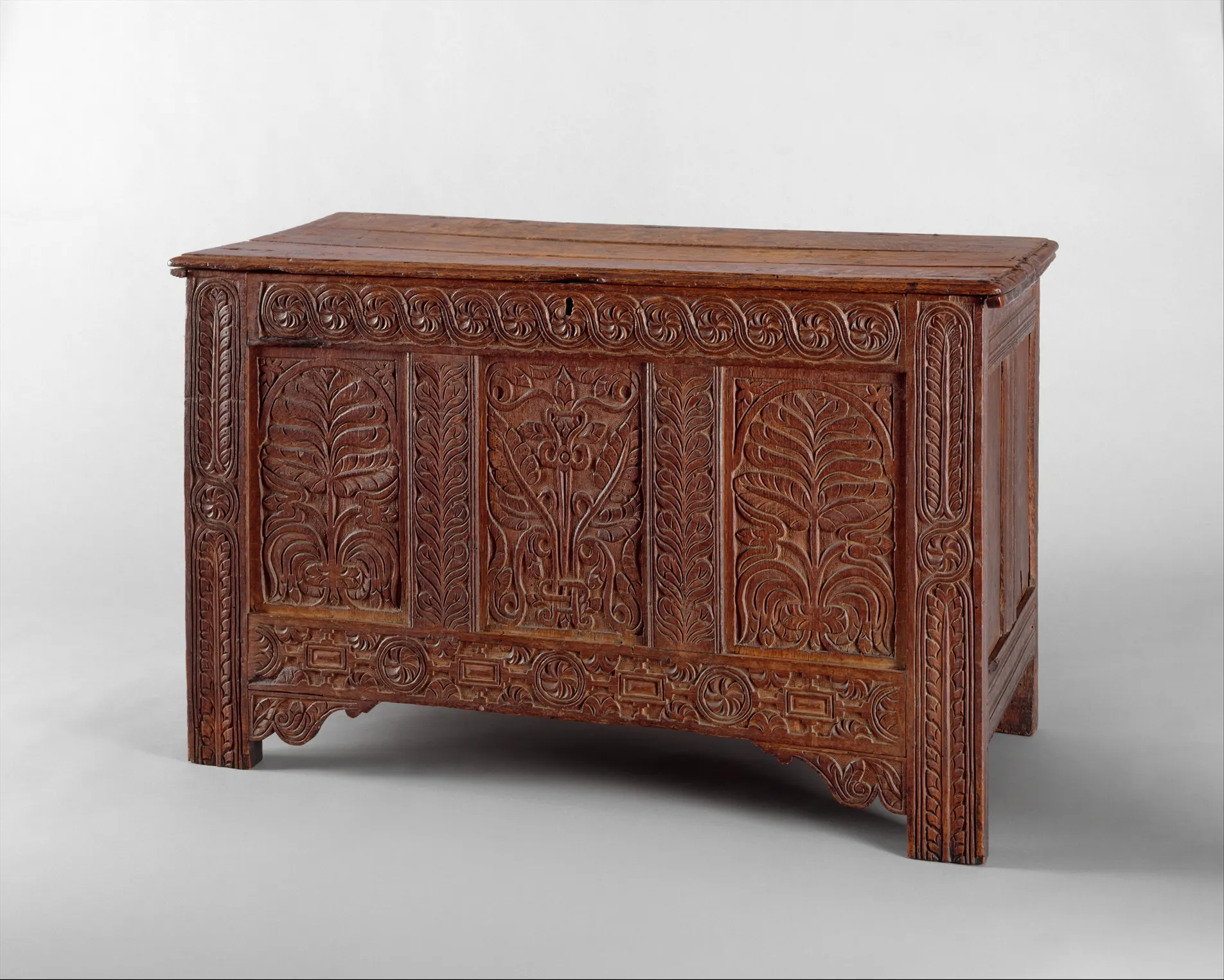
English chest, seventeenth century. Wear concentrated on the edges and around the lock is the map of three hundred years of use: unrepeatable, and the first thing an aggressive restoration erases.
ChestWilliam Searle1663–80 · The Met · objeto 1997 · CC0
Telling a period piece from one in the style
The commercial difference between the two —and what has to appear on the invoice— is explained in the antique furniture buying guide. Here is how they are told apart by looking at the piece:
- Internal consistency. A period piece has the construction of its time everywhere, including where it does not show. A style piece copies the outer form but is built with the means of the workshop that made it: modern screws, thin veneer, plywood.
- Plywood and chipboard do not exist before the twentieth century. Seeing either settles the argument.
- Perfect symmetry. Handwork has deviations of millimetres. A carving in which both sides are identical was made with a copying machine.
The order worth looking in
- Open a drawer and turn it over: dovetails and saw marks
- Look at the back and the bottoms, which were never finished
- Check screws and nails, and whether their holes show earlier traces
- Look for wear where hands touch, and that it is asymmetrical
- Rule out plywood and chipboard anywhere in the structure
None of the five signals decides on its own. What dates a piece is that they all tell the same story: one discrepancy does not condemn it, but three do.
And a warning that applies to all of the above: the style —Isabelline, Empire, Ferdinandine— is not a date. For that there is the page on Spanish furniture styles, which explains which taste each one is and why the nineteenth century remade them all.
And if what you need is not to date a piece of furniture but to decide whether an object is what it is claimed to be, the general check —the four questions hiding inside “is it genuine?”— is in how to tell whether an antique is genuine.