Feriarte
Spain's most important antiques fair. What a vetting committee is, what it actually guarantees and what you still have to check yourself.
- When
- 21–29 November 2026
- Where
- IFEMA Madrid · Madrid
- Official website
- www.ifema.es/feriarte ↗
Galleries and antique dealers
Feriarte is Spain’s most important antiques fair and has been held at IFEMA since the nineteen-eighties. More than a hundred exhibitors, and one thing that sets it apart from any large market: it has a vetting committee.
It is worth understanding exactly what that means, because it is its strongest argument and also the most misread.
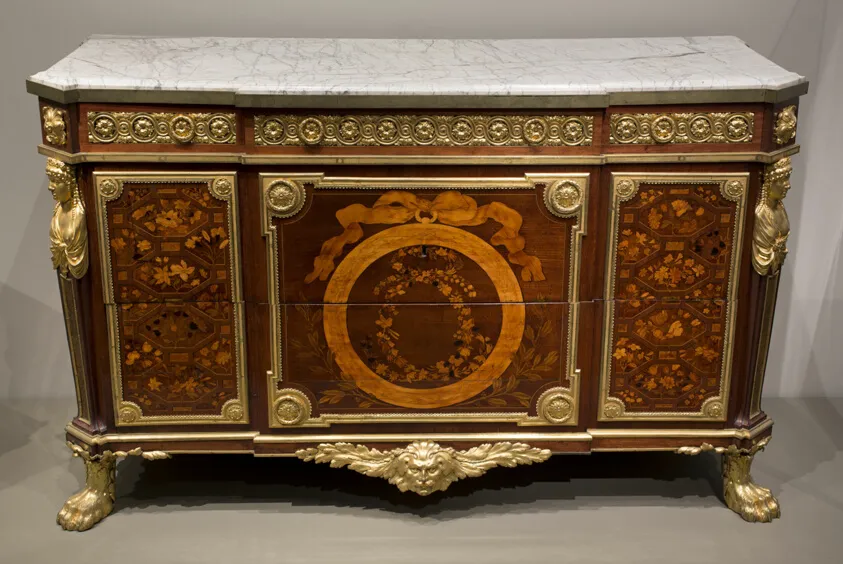
A period piece at a fair is examined exactly as it would be in a shop: from behind, from underneath and inside the drawers. A vetting committee does not change where you have to look.
Chest of Drawers (Commode)Jean Henri Riesener1770–80 · Art Institute of Chicago · obra 109412 · CC0
What a vetting committee is
A group of experts that reviews what is going to be shown before the fair opens, and that can pull a piece off a stand. The seller does not do it: a third party does.
That is a great deal more than a market, a house clearance or a classifieds site offers, where the only filter is the word of whoever is selling. And it explains why Feriarte is where an inexperienced buyer runs the least risk.
But it is worth knowing what it is not. It is not a piece-by-piece appraisal with a signed report. It does not turn a debatable attribution into secure authorship. And it does not replace paperwork: if you buy an eighteenth-century cabinet, the invoice has to say what it is and what restoration it carries, committee or no committee.
The committee greatly reduces the chance of running into a blatant forgery. Everything else is still on you.
What is found there
Classic antiques, weighted more towards the early period than its spring sister: furniture, old master paintings, silver, porcelain, clocks and period jewellery. Art galleries too, which is what keeps the fair from being only for antique dealers.
Along with Almoneda, it is where most houses of the Spanish trade are seen together across four days.
How buying works there
You negotiate, and it is normal. In antiques there is margin. Asking about it offends nobody, especially if you take more than one piece. What does not work is haggling downwards with no argument: somebody forty years in this knows what they have, and a large immediate discount says more about the piece than about the seller.
You ask for an invoice with a description. Author or workshop if there is one, period, materials, dimensions and —this is the one people forget— the restorations. A rebuilt cabinet or a clock with a replaced movement are not worth the same, and that has to be in writing, not said aloud on a noisy stand.
You ask the uncomfortable questions. Is it a marriage? Has it been repainted? What has been done to it? The questions in the category guides work the same at a fair as in a shop, and here you can put them to five stands in a row and compare the answers.
About the last day
There is a widespread idea that everything is cheaper on Sunday. It is half true: taking stock home costs the exhibitor money and there is some margin at the end, but the good things sold on Thursday. What is left on the last day is what nobody wanted for five days.
For a good piece, early. For a bargain, late. They are not the same visit.
And one thing that only happens at a fair
You can see the same type of object on fifteen stands in two hours. Fifteen Isabelline console tables, fifteen prices, fifteen different explanations of why theirs is the better one.
There is no other way to do that, and it is the best market education there is — better even than buying. You can go to Feriarte, buy nothing, and come out knowing three times as much.
Feriarte closes an autumn of four fairs, and it is the only one of the four that vets the pieces before the stands open. The full comparison is in four fairs in nine weeks.
Frequently asked
- What is the vetting committee and what does it guarantee?
- A group of experts that reviews the pieces before they go on the stands and can pull anything that does not meet the standard. It guarantees there is a prior filter independent of the seller, which is more than any market offers. What it does NOT guarantee is that every piece has been appraised one by one, or that an attribution is beyond dispute: you are still the one who asks for the paperwork.
- Can prices be negotiated at Feriarte?
- Yes, and it is done. In antiques there is margin and asking about it is normal, especially if you take more than one piece or pay in cash. What does not work is haggling downwards with no argument: a dealer of forty years knows what they have, and a large immediate discount usually says more about the piece than about the seller.
- Is the last day cheaper?
- Not necessarily, and it is a widely held belief. Taking stock home costs the exhibitor money, so there is some margin at the end; but the best has already sold, and what is left on Sunday is what nobody wanted on Thursday. For a good piece, early; for a bargain, late.
- How does it differ from Almoneda?
- They are sisters —both at IFEMA— but they do not cover the same ground. Feriarte is the November one and its territory is classic antiques, weighted towards the early period. Almoneda is the spring one and reaches into the sixties and seventies, taking in deco and vintage.