Almost everyone buys ceramics by turning the piece over and looking at the mark. That is exactly the reverse of the order used by people who know.
The mark is the easiest thing to fake in the whole category —Meissen’s crossed swords have been copied since the eighteenth century and are still being copied today— so it is looked at last, once the piece has said for itself which family it belongs to and how good it is. Before it come four things that cannot be faked cheaply: the body, the glaze, the modelling and the gilding.
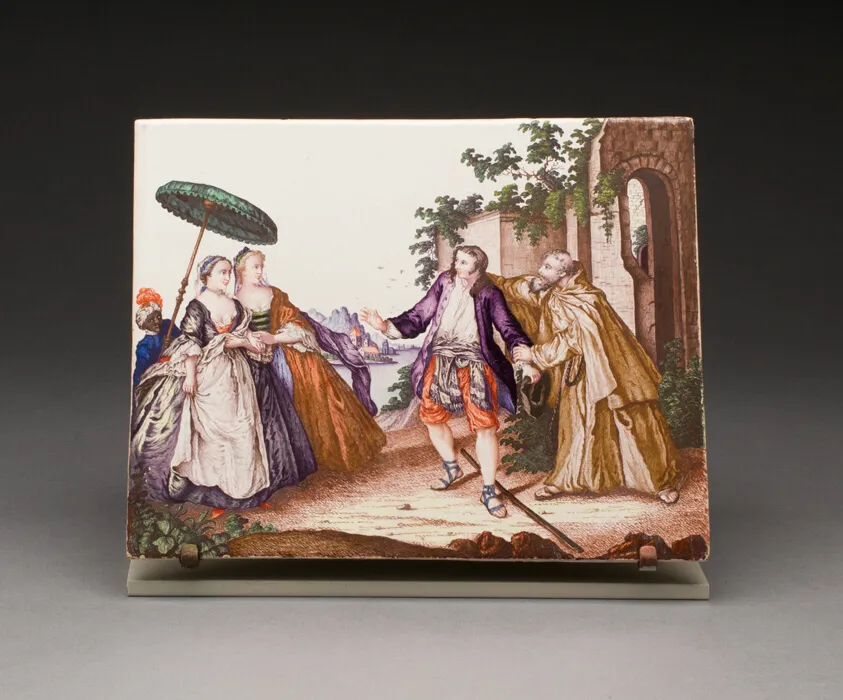
Tin-glazed earthenware plaque, about 1750. A scene painted by hand on tin glaze: every stroke goes onto a surface that absorbs instantly and allows no correction. That impossibility of correcting is what separates a good piece from a later copy, long before anyone looks at the mark.
Plaque: The Geese of Brother Phillippe (Les Oies du Frere Philippe)Künersberg Faience Manufactoryc. 1750 · Art Institute of Chicago · obra 184322 · CC0
One · Porcelain or earthenware, in two seconds
This is not a hierarchy, it is a different family, and confusing them means paying for one and getting the other.
Against the light. Put a bulb behind it. Translucent porcelain lets light through —on fine pieces you can see the shadow of your fingers through the base— and earthenware is entirely opaque.
The edge of a chip. If there is one, it is conclusive: porcelain breaks with a glassy, smooth, cold edge; earthenware exposes a granular, matt interior, biscuit or cream coloured.
The sound. Hold the piece by the rim, in the air, and tap it gently with a fingernail. Sound porcelain rings with a long note. A short, dead thud means a hairline, whether or not you can see it.
Within porcelain, hard paste —kaolin, very high firing, Meissen from 1710— is hard, white and resonant; the soft paste of the early French and English factories is warmer, more ivory, and scratches more easily. And Spanish earthenware from Manises, Talavera or Alcora is not failed porcelain: it is another tradition, older in the Peninsula, with pieces worth far more than much of Europe’s factory porcelain.
Two · The mark: what it says, what it does not, and what it gives away
A genuine mark places the factory and sometimes the period. A mark on its own proves nothing. Three working rules:
The mark has to agree with the piece. A Meissen mark under coarse modelling and flat gilding is a false mark on a mediocre object. A forger copies the symbol, which is the cheap part; they do not copy forty years of skill in the modelling.
A country name dates it. A country of origin —“Germany”, “France”, “England”— points to export pieces from the late nineteenth century onward, and the formula “Made in…” is already twentieth century. A piece declared eighteenth century that reads “Made in Germany” is settled without discussion.
How the mark was applied matters as much as which mark it is. An underglaze mark —painted before glazing, beneath the glassy layer— is hard to fake well and looks slightly diffused, as if floating below the surface. An overglaze mark —on top of the glaze, scratchable with a fingernail— is far easier to add later. If the piece belongs to a period when that factory marked under the glaze and yours is marked over it, there is a conversation to have.
A directory of European factory marks is a separate job and we have not published it yet; in the meantime, the four general questions to ask of any period piece are in how to tell whether an antique is genuine.
Three · The factories people search by name
This is the category where buyers search by maker rather than by object more than anywhere else, so it helps to know who is who.
In Spain. Manises, with its lustreware, Spain’s contribution to European ceramics and bought more outside Spain than inside it. Talavera de la Reina and Puente del Arzobispo, with blue and ochre on white. Alcora, founded in 1727 by the Count of Aranda, the first Spanish factory to compete with the European ones. Carlos III’s Buen Retiro in Madrid, the porcelain of the court. And Sargadelos in Galicia, from 1806.
Abroad. Meissen, Europe’s first hard-paste porcelain, and Sèvres, the French court factory: both heavily copied. And the whole English block —Wedgwood, Worcester, Derby— where the most pieces circulate at sensible prices.
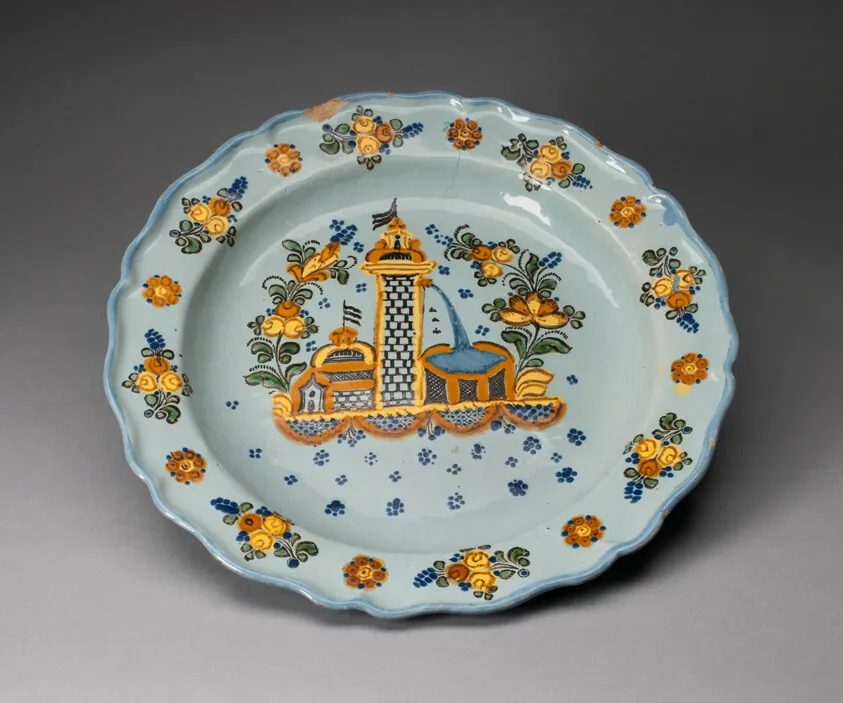
Talavera poblana dish, around 1800. Mind the name, because it is the most expensive confusion in this category: 'talavera poblana' is from Puebla, in Mexico, not from Talavera de la Reina. They share a technique and a root —the Mexican tradition grows out of the Spanish one in the sixteenth century— but they are different markets at different prices.
Large PlateTalavera Poblana1775–1825 · Art Institute of Chicago · obra 10507 · CC0
Four · The restoration nobody declares
Ceramics restore better than almost any other material, which is why this is where the most is hidden. Four checks you can make standing up, in a shop:
A fingernail around the rim. Run it along the whole edge. A filled chip registers as a change of texture or a small step long before it becomes visible.
Touch and temperature. Filler resin feels warmer than the ceramic around it, and it sounds different: the restored area does not ring.
Sheen at a raking angle. Look at the piece against the light while turning it. Retouching has a different sheen —usually duller or, conversely, too uniform— and the boundary of the repainted area draws itself.
Ultraviolet light. A cheap torch settles most cases: modern restoration materials fluoresce differently from ceramic and old glaze, and a rebuilt handle shows up as an obvious pale patch.
None of this makes a restored piece a bad buy. What makes it a bad buy is paying for it as though it were not restored.
Five · What reduces value, in order
- A hairline, even one invisible head-on.
- A chip on the rim, which is also where everyone looks.
- Undeclared restoration, which costs twice what declared restoration costs: one disappoints, the other breaks trust.
- Regilding. A gilt rim worn by use is history; a modern regilded rim looks too new and pulls the piece down.
- A lid that is not its own. Very common on tureens, teapots and boxes. Check that it seats without play and that the whites match.
- The dishwasher. On gilded or overglaze-painted pieces, once is enough.
Six · What to ask
- Does it have restorations? Which, and where? (And put it on the invoice.)
- Are the lid and the body from the same service?
- Is the mark underglaze or overglaze?
- Which factory and which period, and on what basis?
- Is the service complete? How many pieces exactly?
What it costs
Twentieth-century European factory ceramics are among the most affordable things in the trade: bought well, used, and no money lost. Early Spanish earthenware in good condition —lustred Manises, seventeenth and eighteenth century Talavera, Alcora— sits above that, and Buen Retiro and court porcelain play in another league.
The most sensible purchase in the whole category is still the same one: a good incomplete service, which costs a fraction of the complete equivalent and is used in exactly the same way.
And if what you want is somebody to buy it from, the directory of antique dealers lists the houses that work this family, with province and speciality declared. The rules we ask of them are in the pact.