This is the only family in the trade with a guaranteed floor: beneath everything else, a piece of silver is always worth the metal in it. And that security, which looks like an advantage, is the reason this category loses more good pieces every year than any other.
Because the floor is also a door. An eighteenth-century salt with its assay mark and its silversmith’s stamp is worth several times what it weighs; at a cash-for-gold counter it is worth what it weighs, and it leaves on its way to the crucible. The gap between those two numbers is everything you need to know before selling — and much of what you need to know before buying.
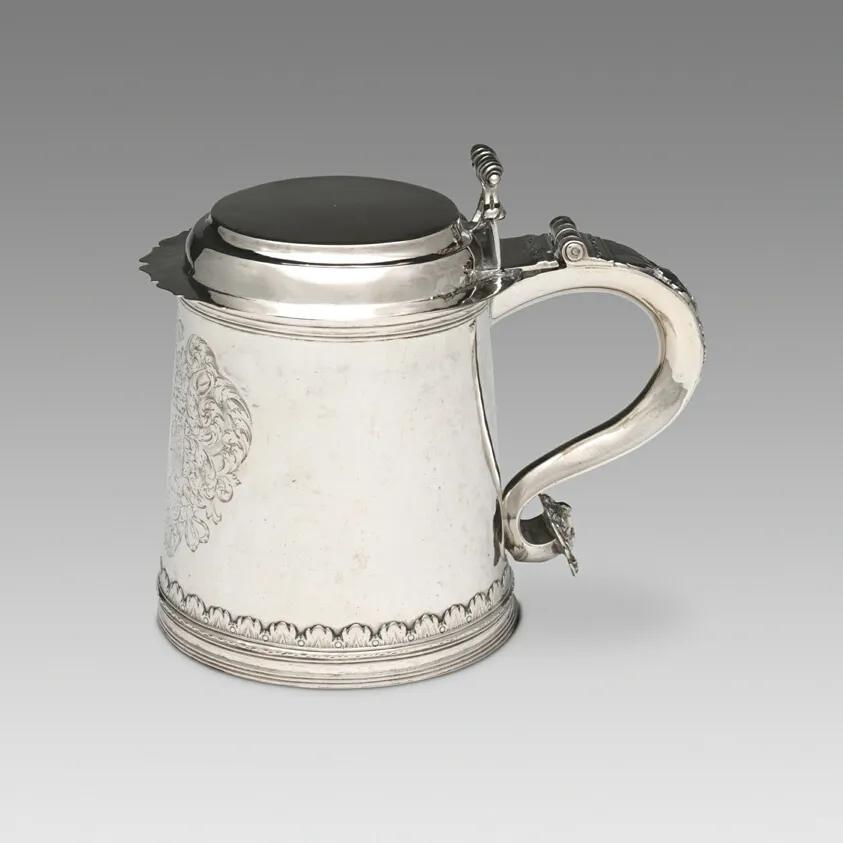
Silver tankard, first quarter of the eighteenth century. A body raised with a hammer from flat sheet, with the handle cast separately and soldered on: each of those operations leaves marks a modern stamped piece cannot have, and they are what survives beneath the patina.
TankardCornelius Kierstede1700–20 · Art Institute of Chicago · obra 55119 · CC0
One · Silver, plate, and what is neither
Three families that look alike from a metre away and feel nothing alike in the hand.
Sterling silver. Carries hallmarks and ages by tarnishing to an even bluish black. It has weight. Tapped gently, it answers with a long note.
Plate. A layer of silver over another metal. It ages the other way round: wearing through first where it is handled —rims, handles, the edge of a tray, the tip of a spoon— with reddish copper or yellow brass showing underneath. It is not a fraud: there is excellent antique plate, and a nineteenth-century English fused plate tray is a legitimate piece with a market of its own. What cannot happen is being sold it as silver.
Nickel silver, or white metal. Copper, nickel and zinc. Not a gram of silver. It is most twentieth-century cutlery, and it is worth what it is worth as something to use — which is not nothing, but it has no precious-metal floor.
Spanish hallmarks have a page of their own, because reading them is a craft in itself and Spain never had a national system like the British one: it is all in Spanish silver hallmarks, with the three marks a piece carries and why the Castilian standard was not 925 but eleven dineros and four granos.
Two · Why melting is almost always the worst deal
It is worth saying in round terms, even though metal prices move.
Melt value is weight times price, minus loss and minus the margin of whoever melts it. It is a small number, and it is the same for a piece from 2020 as for one from 1780.
The value of the piece adds workmanship, maker, city, period, rarity of the form and condition. On eighteenth-century Spanish silver, on signed goldsmiths’ work, or on anything documented, that second number is not ten per cent higher: it can be several times the first.
Hence the only rule that really matters here: before selling by weight, show it to someone who buys pieces. That costs an afternoon and is reversible. The crucible is not.
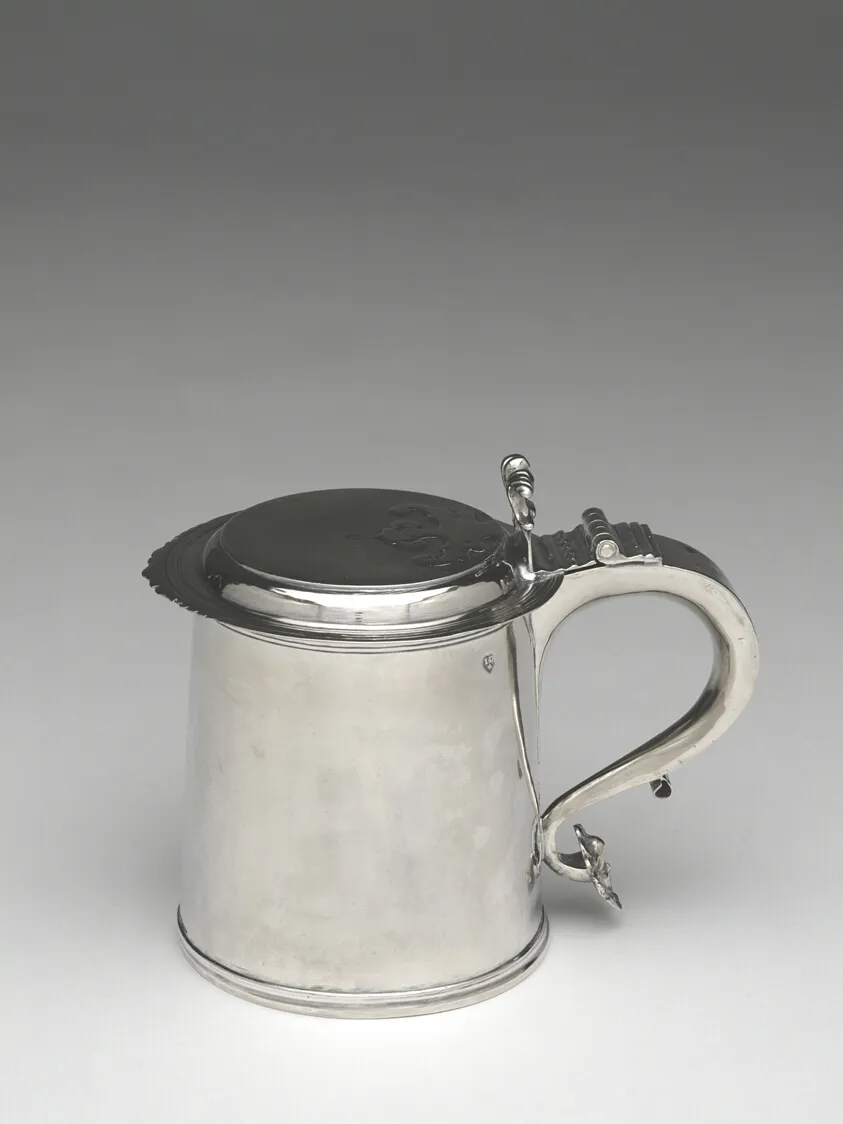
Colonial silversmith's tankard, about 1705. What multiplies the price of a piece like this is not the silver in it: it is that we know who made it, where and when. Melted down, all of that is worth exactly what a modern spoon of the same weight is worth.
TankardJeremiah Dummerc. 1705 · Art Institute of Chicago · obra 104676 · CC0
Three · What destroys value, and nearly all of it is avoidable
Over-polishing. The leading cause by a distance. Aggressive polishing rounds the edges, flattens engraving and eats the hallmarks — which are precisely what gives the piece its value. It is irreversible. More good silver has been lost to a cloth and abrasive paste than to every theft combined.
The erased monogram. It thins the silver in that area, and it shows if you breathe on the surface: the ghost of the old engraving appears. It tells a buyer two things, both bad — that the piece has less metal than it appears to, and that somebody wanted to hide its history.
Modern solder. A handle resoldered with tin reads as a dull grey line, different from the shine around it. It costs a good deal, and on pieces made to be used —jugs, sauceboats— it is the first thing to check.
Added engraving. A crest or initials cut today into an old piece to “give it history” is a problem, not an improvement: it shows in the cut of the graver, cleaner and deeper than worn period work.
Dents on the rim of a tray, which force expensive and almost always visible restoration.
What does not cost anything: patina. Silver that has spent two hundred years darkening in the recesses and brightening where it is handled is telling you its age. Leaving it alone is the right decision.
Four · Ormolu, copper and brass
The other half of the category, and the least understood.
Gilt bronze —furniture mounts, candelabra, mantel clocks, wall lights— is bought for the gilding and destroyed by cleaning. The gold layer is extremely thin and any metal polish removes it in one pass. Dust it with a soft brush and stop there. On pieces from before the mid nineteenth century the gilding was done with mercury and has a warm, slightly uneven colour; modern regilding gives itself away by being too yellow and too even.
Copper and brass for kitchen and table —pans, cauldrons, mortars, braziers— are the cheapest way into the category and among the most rewarding. They are bought for form, weight and honest use: a riveted, worn base is worth more than a flawless one, because the flawless one is usually recent.
Five · Altar silver, and a warning
Chalice, ciborium, monstrance, chrismatory, pax. This is liturgical material, and it is where the category meets a serious problem: much of the altar silver in circulation left parish churches, and protected ecclesiastical property is imprescriptible — time does not clean it.
That does not mean religious silver cannot be bought: a great deal was disentailed, legally sold, or civil in origin. It means that here provenance is not an extra, it is the purchase. How to ask for it, and why good faith does not confer ownership, is in how to tell whether an antique is genuine and told through a real case in sixteen years do not launder a stolen piece.
Six · What to ask
- Is it sterling, plate or nickel silver? What hallmarks does it carry and what do they say?
- What does it weigh? (And put the weight on the invoice.)
- Has it been over-polished? Is there an erased monogram?
- Does it carry solder or repairs? Where?
- If it is liturgical: where did it come from, and is there paperwork?
What it costs
Copper and brass for use are the cheap door in. Twentieth-century sterling cutlery sells barely above weight, which makes it the best buy for anyone who actually wants to use it. Spanish silver of the seventeenth and eighteenth centuries with an identifiable assay mark, and signed goldsmiths’ work, are another matter — and there the metal stops setting the price.
The houses that work this family are in the directory of antique dealers, with province and speciality declared — and with the pact written alongside, which is what we ask of them in return for being listed.