Sixteen years do not launder a stolen piece
A 16th-century relief left a Navarrese monastery in 2010 and resurfaced at a Barcelona auction house. What happens to the man who bought it in good faith.
On 4 August, a parish priest in Fitero was handed a carved, gilded and polychrome wooden relief measuring 81 × 45.5 × 10 centimetres by officers of the Spanish National Police and the Catalan Mossos d’Esquadra. It depicts Saint Bonaventure, is attributed to the circle of Juan de Anchieta, and formed part of the Immaculate Conception altarpiece at the monastery of Santa Clara. It had been missing since 2010.
In between lie sixteen years and a journey worth looking at slowly, because it is the ordinary journey.
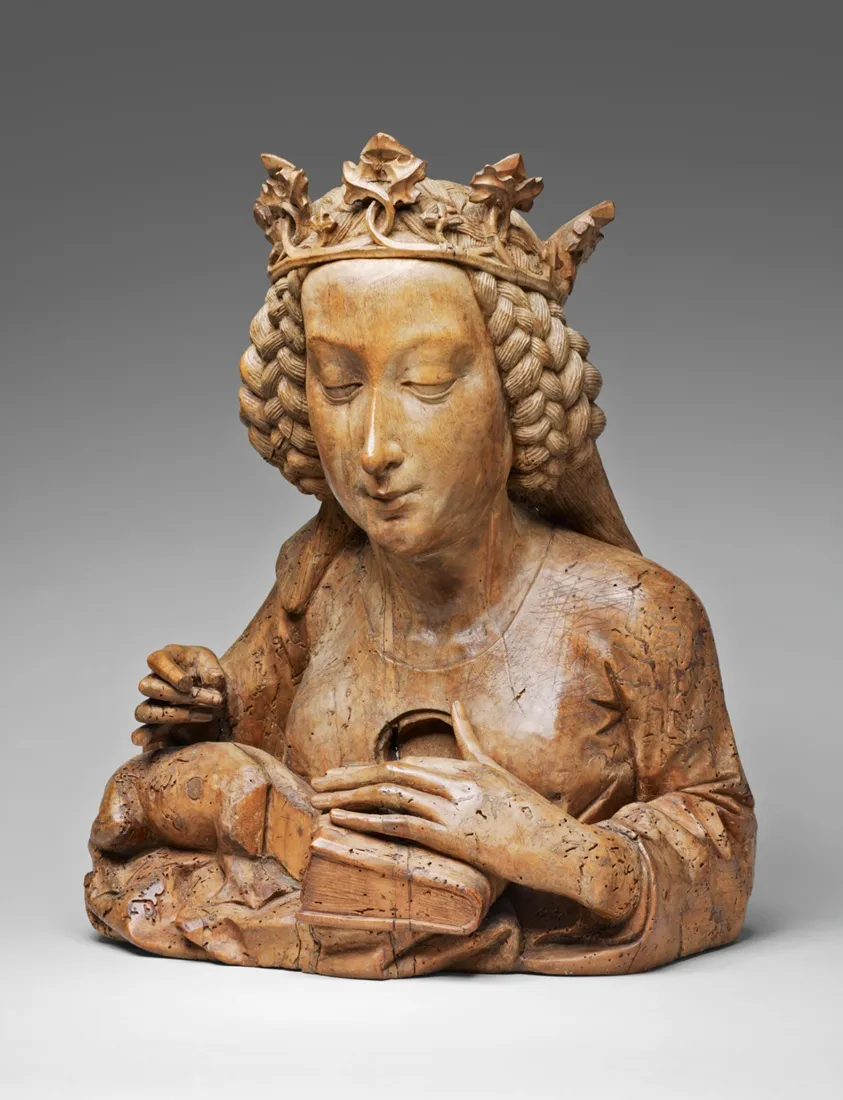
Reliquary bust of Saint Margaret of Antioch, Nicolaus Gerhaert, around 1470. This is not the Fitero piece: it is an example of the same kind of object —a devotional carving of a saint, in wood— so the reader can see what we are talking about. The image comes from a public collection in the public domain.
Reliquary Bust of Saint Margaret of AntiochNicolaus Gerhaertc. 1470 · Art Institute of Chicago · obra 48715 · CC0
The route of a piece that should never have been on the market
The Poor Clares left the monastery in 2009. The relief disappeared the following year. According to the investigation, it began its journey at the Rastro, the Madrid flea market, passed through several buyers and was finally identified at a Barcelona auction house that was preparing to sell it. The Mossos located it in April 2026 through its current owner, who had bought it at that same auction house without knowing where it came from.
One detail is worth pausing on, and almost every report skipped it: the piece was not found hidden, but about to go into a catalogue. What made it findable was precisely the moment it entered a channel that publishes what it sells. An object passing hand to hand for cash leaves no trace; one that gets catalogued does.
Two clocks that never reach zero
Here is what matters to anyone buying period work, and it is one of the few things in this trade that is written down in black and white.
Good faith protects you, but not in the way people assume. Article 464 of the Spanish Civil Code says that whoever has been unlawfully deprived of a movable good may reclaim it from whoever holds it. And it adds a decisive qualification: if the holder acquired it in good faith at a public sale, the owner cannot recover it without reimbursing the price paid. In other words: good faith does not give you title, it gives you a right to your money back. You lose the piece either way.
With church property, the clock does not run. Article 28 of Law 16/1985 provides that movable goods declared of cultural interest, or listed in the General Inventory, held by ecclesiastical institutions may not be transferred or ceded to private individuals or commercial entities, and are imprescriptible: it states expressly that article 1955 of the Civil Code does not apply to them — the article that otherwise allows title to a movable good through three years’ possession in good faith, or six without it.
Translated: with an ordinary object, time eventually works in favour of whoever holds it. With protected ecclesiastical property, it does not. Sixteen years do not launder it, and forty would not either.
What the reports do not say —and we will not invent it— is whether the Barcelona buyer got his money back, and from whom. How those two rules interact is exactly what ends up in court when this happens.
What a buyer can do before paying
None of these checks costs money, and doing them is the difference between a disaster and an afternoon.
Ask for the provenance chain in writing. Not «from a private collection»: from whom, when, and on what document. A serious house either has it or says honestly how far back it can go. An absence of paperwork does not prove a piece is stolen —a great deal of legitimate antique material circulates without an archive— but it changes who carries the risk, and that should show up in the price and in writing.
Check the stolen works database. The Interpol database can be consulted. The Spanish one is called Dulcinea, is maintained by the National Police’s Historical Heritage Brigade and is not open to the general public: if there is serious doubt, the route is to ask the Brigade, not to stay quiet.
Be wary of religious art with no history. It is the genre with the most theft and the least protection: devotional carving, dismantled altarpieces, sacristy ironwork, pieces that left rural parishes with nobody watching. If a sixteenth-century saint turns up and nobody says which church it came from, the question is not rude. It is the question.
Notice whether the house publishes what it sells. The Fitero case proves it in reverse: the piece was recoverable because somebody catalogued it. Buying through a channel that leaves a trace protects the buyer too.
And what a house should do
The same thing, earlier: check, document and keep a record of where each object came from. It is work, and it is exactly the work that separates a professional from a middleman. An antique dealer who can show you a piece’s route is selling something more than the object.
This directory was built on that idea. Every listing keeps the address of where its information came from, and we do it because it seems unreasonable to demand provenance from a seller if we will not give it for our own data. The rules are written in the pact, dated, so they can be held against us.
If you are buying carving, religious imagery or altarpiece work, the antique sculpture guide explains what to look at before paying. And if you want to know who you are dealing with, there is the directory of antique dealers.
Sources: statements from the Spanish National Police and the Mossos d’Esquadra reported on 4 August 2026 by eldiario.es, Telemadrid, Infobae, Alfa y Omega and Estrella Digital. The legislation cited links to the consolidated text on the BOE.