Sculpture is the category with the least competition online and one of the richest in exceptional pieces below their value. It is also the one that demands most knowledge, because the material changes all the rules: what you look at in a bronze bears no resemblance to what you look at in a polychrome carving.
This guide goes material by material.
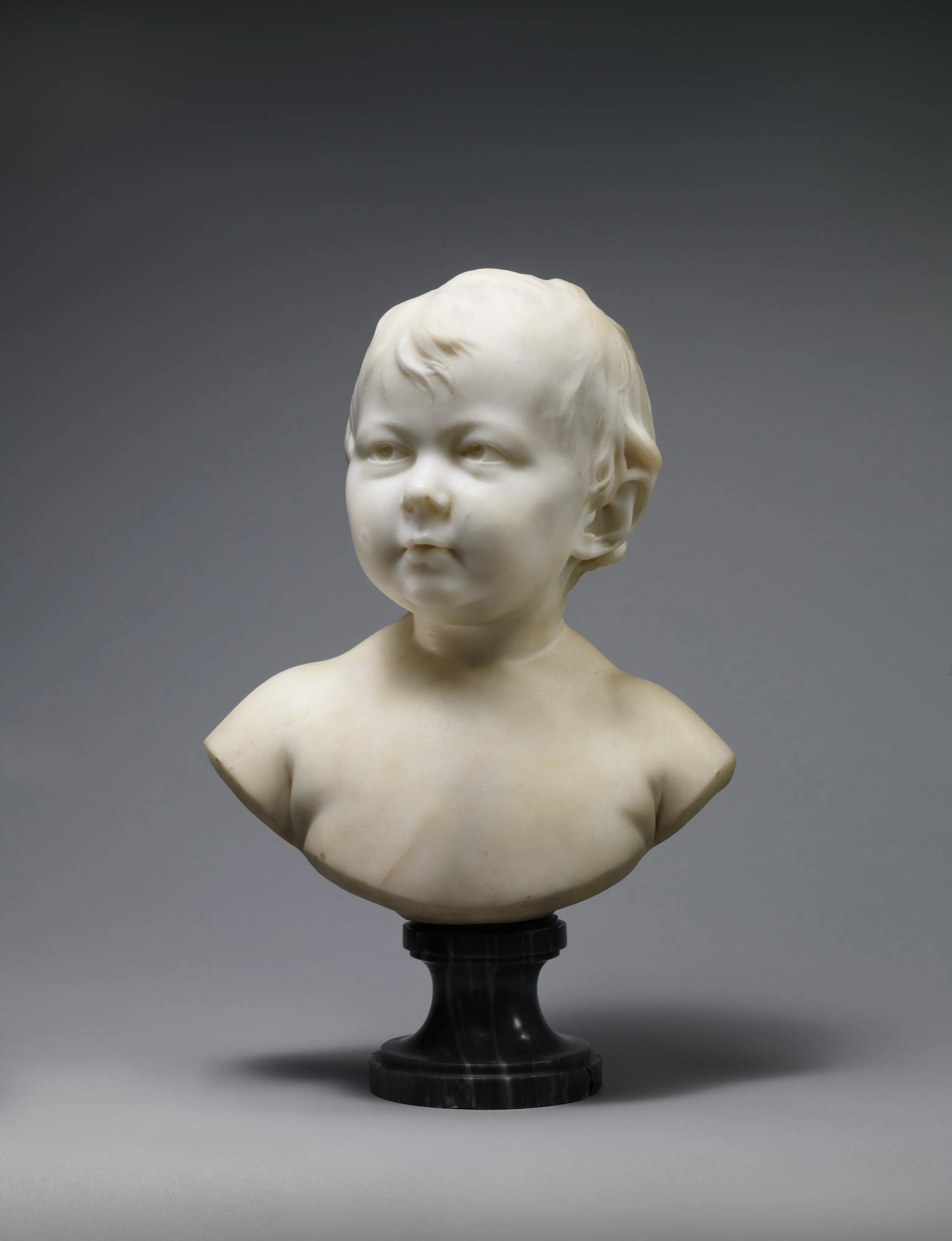
Bust of Sabine Houdon by her father, 1788. Portrait marble from the finest French moment: in a piece like this what is paid for is the sculptor's hand, which is why attribution is everything.
Sabine Houdon (1787–1836)Jean Antoine Houdon1788 · The Met · objeto 200668 · CC0
Bronze: count what has shrunk
This is the material where original and copy are most often confused, because in bronze every example in an edition is an original. The problem is a different one: later casts, taken from an existing bronze rather than from the artist’s mould.
They are detected by three things:
Size. Each generation of mould shrinks by around one per cent. It does not sound like much, but if you know the measurements of the documented model and the piece is three centimetres short in forty, you are looking at a copy of a copy.
Detail. A late cast loses its edge: borders round off, folds flatten, surface textures —fingermarks, the traces of modelling— disappear. Compare an area of fine detail with a photograph of the original if you have one.
The marks. Look for the foundry mark —Barbedienne, Susse, Valsuani, Codina— and the edition numbering. And look inside from the base: a lost-wax bronze has an irregular internal surface; a sand cast, a grainier and more uniform one.
And do not clean the patina. It is part of the work and was often the artist’s decision. A bronze polished to a golden shine has lost much of its price.
Marble: look for the tool
In marble what is paid for is the hand, and the hand leaves marks that can be read in the unpolished areas: the reverse, the base, the inside of the folds.
The drill —the bit that makes deep holes for pupils and curls— leaves clean perforations. The toothed chisel leaves parallel furrows. An entirely smooth surface with no trace of tooling points to a modern mechanical finish.
Two warnings. First: marble can be aged. Burying it, treating it with acids or with earth gives a surface that looks old, so uniform and agreeable ageing should make you more suspicious than irregular staining. Second: much of what is sold as marble is alabaster —softer, more translucent, scratched with a fingernail— or reconstituted marble, which is powder bound with resin and has nothing to do with the case.
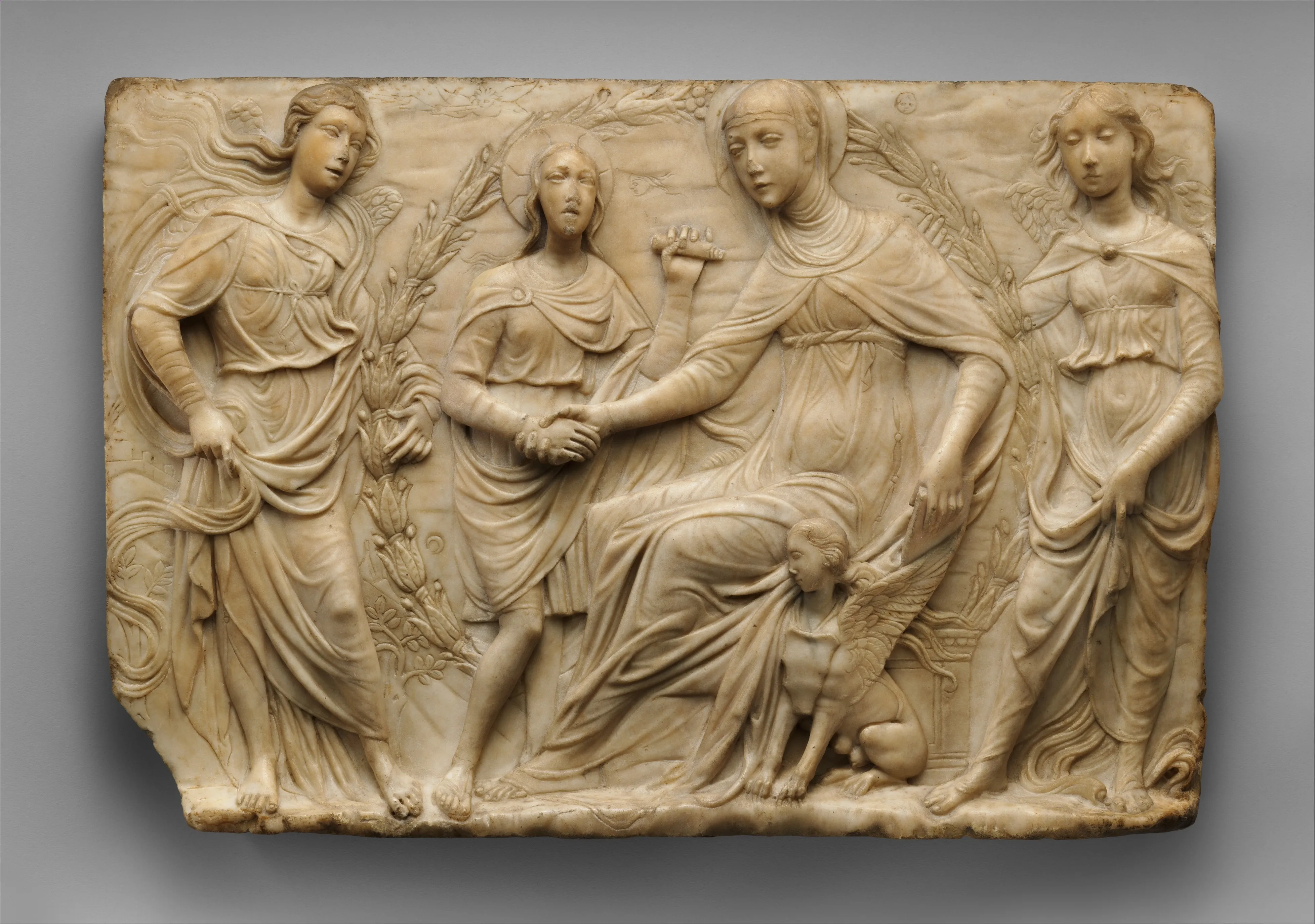
Florentine relief, 1459. In Italian devotional sculpture of the Quattrocento the surface keeps traces of original polychromy and gilding: removing them to «clean» the piece was standard practice for decades and is today considered a disaster.
Saint Bridget of Sweden Receiving the Rule of Her OrderAgostino d'Antonio di Duccio1459 · The Met · objeto 192770 · CC0
Polychrome wood: almost everything is in the paint
This is the ground where Spain has the best in the world, and where most value is destroyed by good intentions.
In a carving from the sixteenth to eighteenth centuries, the original polychromy —with its craquelure, its losses, its burnished gold underneath, its estofado— is most of what is being paid for. And it is exactly what is lost when somebody decides the figure «looks dull» and repaints it.
How to detect repainting:
- The colour is flat and uniform, without the depth of the old layers.
- There is no craquelure, or only in some areas.
- The flesh tones —face and hands— give most away: the old polishing technique gives a finish modern paint cannot achieve.
- Under ultraviolet light, the modern layer does not fluoresce as the old one does.
Look also at the structure: large carvings were made from several assembled pieces and hollowed out at the back to stop the wood splitting. A solid carving in one piece at large scale is rare.
Terracotta: fragile and very datable
Terracotta is the material of the bozzetto, the preparatory model, and also of much decorative sculpture of the eighteenth century. It is cheap to produce and fragile to keep, so:
- Look for restoration at necks, fingers and projections, which is where it breaks.
- A uniform dark varnish is usually covering fills.
- Late moulds exist just as in bronze: same criterion of size and softness of detail.
An intact terracotta, with no breaks, is rare, and that alone is worth something.
What to ask
- What material is it exactly? Marble or alabaster? Bronze or alloy?
- In bronze: which foundry, what edition number and from which mould?
- Are the patina or the polychromy the original ones?
- Which parts are modern replacements?
- Has it been outdoors?
- What provenance documentation is there?
What is paid in the Spanish market
Large work is cheap, as with furniture and for the same reason: a life-size carving or a monumental marble is magnificent and does not fit in a house. If you have the room, it is the best art per euro the market offers.
Religious work too, and it is the most extreme case in the trade: Spanish devotional sculpture of the very first quality, from the seventeenth and eighteenth centuries, at prices that bear no relation to its merit, because the domestic market rejects it. Anyone buying for pleasure rather than resale has an opportunity there that is unlikely to come again.
What does rise: signed bronze at tabletop size, marble portraiture by a good hand, and any piece with provenance from a known collection.