How to clean antique furniture without ruining it
What you can do at home, what is never touched, and how to tell dirt from patina. The line between cleaning and ruining, before it is too late.
Reviewed on
Almost all the damage an antique piece suffers in private hands is done with good intentions, on a Saturday afternoon. It is not use, or damp, or sun: it is the stripper, the sandpaper and the supermarket furniture polish, applied by someone who wanted to make it look nice.
This page is about exactly where the line is, because once crossed there is no going back and the loss in value is immediate.
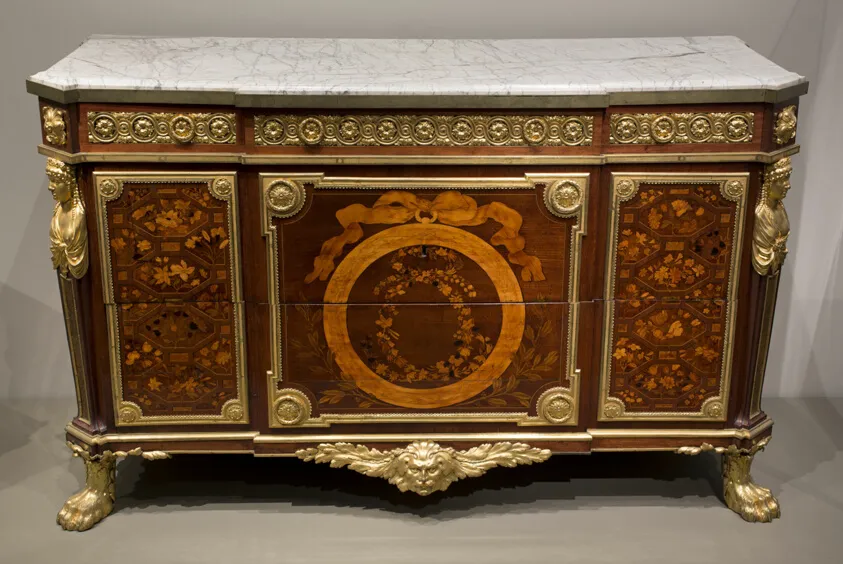
Riesener chest of drawers, circa 1770. On a piece like this the deep glow of the wood is not recent varnish: it is the sum of two and a half centuries of oxidation, wax and hands. That is what a stripper removes in twenty minutes.
Chest of Drawers (Commode)Jean Henri Riesener1770–80 · Art Institute of Chicago · obra 109412 · CC0
Patina is not dirt
This is the distinction that decides everything, and confusing the two is what ruins pieces.
Patina is what happens as wood ages: oxidation of the surface, uneven wear in the areas of use, the darkening of the pores, the small knocks accumulated along the way. It has formed over decades or centuries and cannot be put back. It is, literally, the part of the piece that proves it is old.
Dirt is what has settled on top: grease, smoke, dust compacted with old wax, residue of products. It sits on the finish; it is not part of it.
The practical test: dampen a cotton wool bud with saliva or distilled water and pass it gently over a hidden area —the inside of a door, the back of a drawer—. If the cotton comes away brown and the wood underneath is the same tone as the rest, that was dirt. If the wood is left lighter than its surroundings, you have started removing patina. Stop.
Before touching anything, know what finish it has
What the wood is protected with decides what you can use on it. Applying the wrong product to the wrong finish is the quickest way to turn a clean into a restoration.
Shellac (French polish). The dominant finish from the eighteenth century until well into the twentieth. It gives a warm, deep shine, and it is soluble in alcohol: that is the danger, because any cleaning product containing alcohol dissolves it on the first pass. The test, always in a hidden area: a cotton bud barely damp with alcohol; if gentle rubbing tints the cotton golden brown, it is shellac. Never bring alcohol near it again.
Wax. Common on country furniture and on pieces waxed for generations. A matt or softly lustrous surface with a slightly greasy feel. It is recognisable because running a fingernail along an edge leaves a mark. It is the most forgiving finish: it is maintained with more wax and takes gentle cleaning without drama.
Oil or copal varnish. Harder and glossier, common on nineteenth-century English furniture. It does not dissolve in alcohol, but it does in strong solvents that also attack what lies beneath. Here, surface cleaning and nothing more.
Polyurethane or modern varnish. If the piece is old but the finish is a bright, perfectly uniform plastic, somebody revarnished it in recent decades. The bad news has already been delivered; the good news is that in that case the historical value of the finish is already lost, and the precautions stop being so critical.
One detail that settles a lot of doubts: look at the inside of a drawer. It was almost never finished or retouched, so it shows the original wood and colour, and serves as a reference for how much the outside has darkened.
What you can do
Little, and that is the right answer.
Dusting. A dry cotton cloth, or a soft brush for mouldings and carving. No feather dusters with products on them.
A very gentle surface clean. Neutral soap heavily diluted in distilled water, applied with a wrung-out cotton bud, not a wet one, and dried immediately with a dry cloth. Area by area, small. Water is the enemy of the animal glue antique furniture is assembled with: never soak, never leave moisture sitting in a joint.
Waxing, with caution. Pure beeswax, in very small quantity, spread with a cloth and buffed twenty minutes later. It feeds the surface and gives a deep shine. Twice a year is more than enough; waxing every month builds up layers that trap dust and end up forming an opaque crust.
Stabilising the environment. The most useful thing on this whole list, and it does not touch the piece: relative humidity between 45 and 60%, away from the radiator, away from a window in direct sun. Sudden swings in humidity open joints and lift veneer.
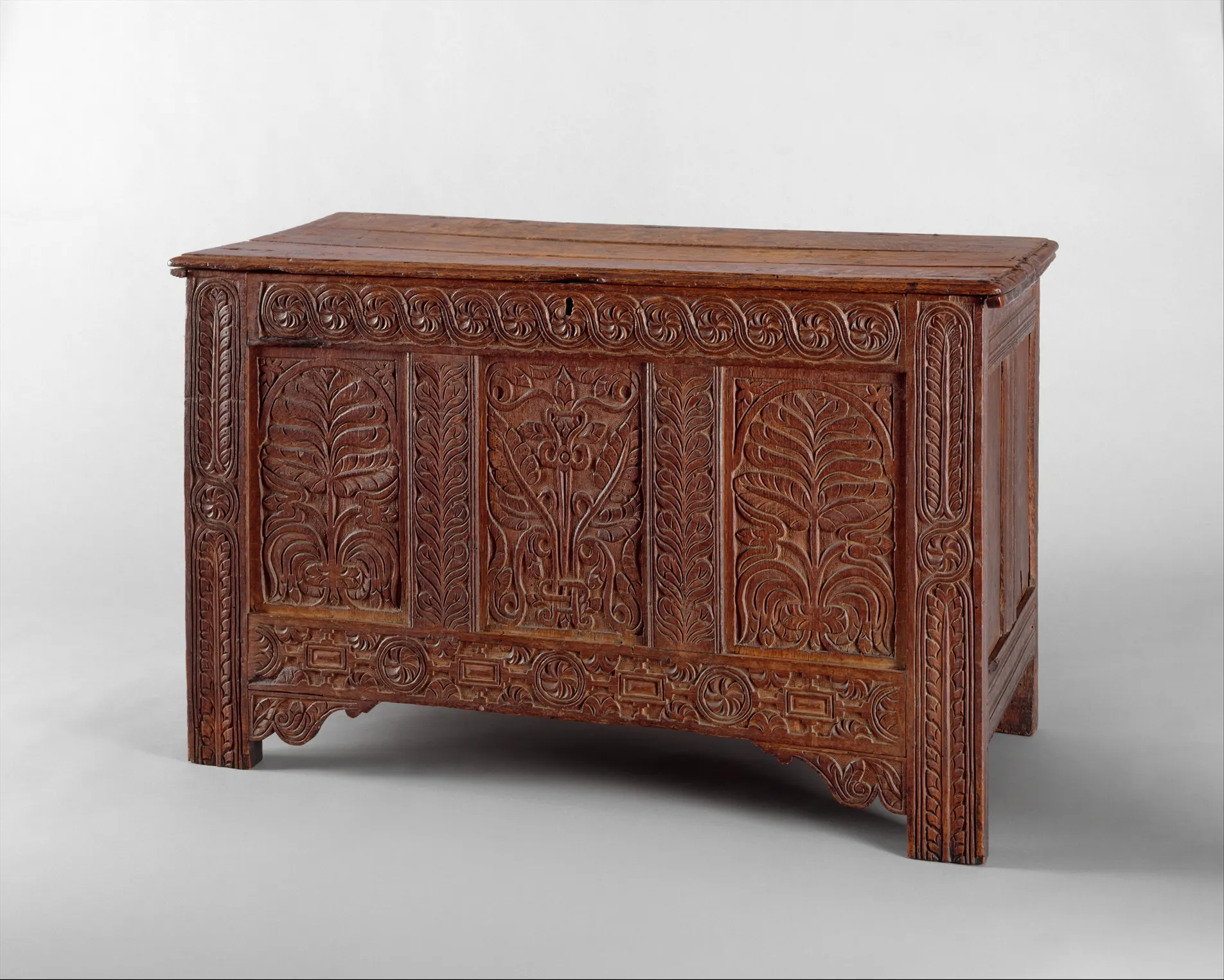
English chest, seventeenth century. Wear concentrated on the edges and around the lock is exactly the map of use that an aggressive restoration erases — and the first thing an antique dealer looks at.
ChestWilliam Searle1663–80 · The Met · objeto 1997 · CC0
What you must never do
Strip it. This is the death sentence. It takes the original finish, the patina and much of the value in one go. A stripped piece can lose more than half its price, and there is no undoing it.
Sand it. Equally irreversible. Besides the patina, sandpaper removes the trace of the original tool —plane marks, irregularities of the working— which is one of the things a piece is dated by.
Varnish over it. Modern synthetic varnish seals the piece, stops the wood breathing and gives an unmistakable plastic shine. And removing it afterwards requires solvents that do attack what lies beneath.
Oils and supermarket furniture polish. Linseed oil and silicone sprays leave a sticky film that darkens over the years and complicates any future work. A restorer recognises a piece «treated» with these products the moment they see it.
Change the hardware. Original handles, escutcheons and hinges, even mismatched or worn, are worth more than any new replacement. If you have to replace one, keep the old one: it is part of the piece.
Fix a joint with PVA glue. Modern glue is irreversible; the original animal glue reactivates with heat and moisture, which is precisely what allows a piece to be taken apart and reassembled without destroying it. A joint glued with PVA is condemned for ever.
Signs to stop and call someone
- The veneer is lifting, bubbling, or a piece is missing.
- There are woodworm holes with fresh pale dust around them: the insect is active right now.
- The piece rocks or shifts when leant on: joints are open and continuing to use it opens them further.
- There are white bloom marks from damp under the finish.
- Gilding, polychromy or marquetry appear anywhere. Nothing gets touched there: they are separate specialities and each has its own technician.
What it costs and when it is worth it
Serious restoration is not cheap, and it is not always worth it: on a piece of modest value it can cost more than the piece. The sensible rule is to ask for a written estimate with a diagnosis, not a price off the top of someone’s head, and for the estimate to say what will be done and what will be left alone.
A good restorer proposes doing less than you expected. If someone offers to leave it «like new», you are talking to the wrong person: in antique furniture, «like new» is exactly the result that sinks the price.
And if the intention is to sell, there is a consequence that surprises almost everyone: it is usually better not to restore. The professional buyer would rather decide themselves what gets touched, with their own judgement and their own workshop, and pays more for a piece that is intact and dirty than for one worked on to somebody else’s taste.
In short
Dusting, a very gentle clean with neutral soap and distilled water, beeswax twice a year and stable humidity. Everything else —stripping, sanding, varnishing, gluing, replacing— belongs to another trade.
Patina takes a century to form and twenty minutes to disappear. That asymmetry is the whole of the advice.