Estampa
Prints and contemporary art at IFEMA. What is found there, what it costs to start collecting and what to ask at a stand.
- When
- 24–27 September 2026
- Where
- IFEMA Madrid · Madrid
- Edition
- 34ª
- Official website
- www.ifema.es/estampa ↗
Galleries
Of all the fairs in the Spanish calendar, Estampa is the easiest to recommend to someone who has never bought art. Not because it is the most important —it is not— but for a practical reason: it is where the price floor is lowest without the quality of what is sold coming down with it.
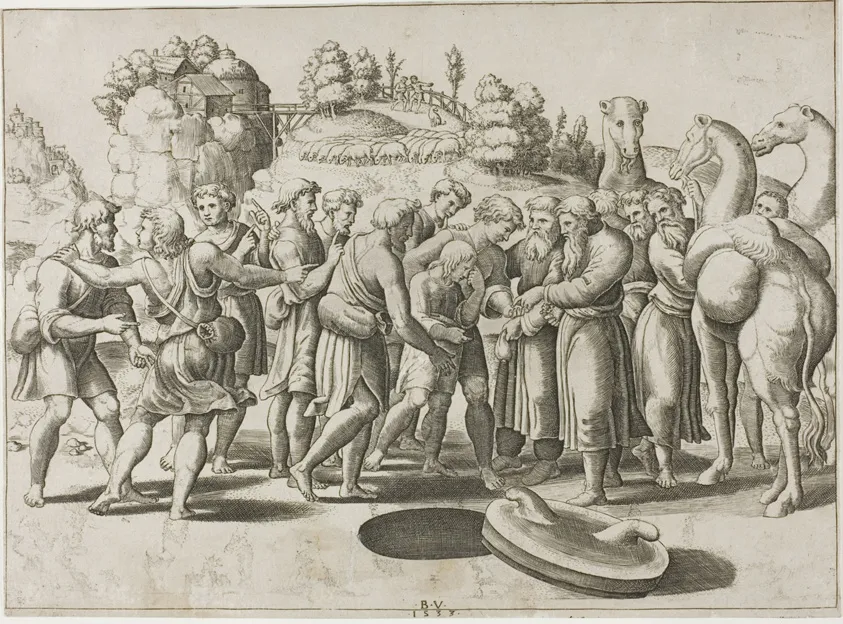
Burin engraving, 1533. Prints have spent five hundred years being the way an image reaches more than one house. They are also the oldest way of starting a collection.
Joseph Sold by his BrothersMaster of the Die1533 · Art Institute of Chicago · obra 34 · CC0
What it is
A contemporary art fair weighted towards prints and multiples, at IFEMA. It is in its 34th edition, which among Spanish fairs is a seniority only ARCO and Feriarte share.
Being centred on prints does not make it a lesser fair: it means the object being sold is an original work conceived to be printed, with its numbered edition and its matrix, not a reproduction. That is the distinction that decides the price and the one most often confused — it is explained in full in the guide to prints and drawings.
Why it is the fair to start at
Because you can buy. At a modern art fair the floor is tens of thousands of euros and most visitors go to look. At Estampa you find original work by living artists for a few hundred, and that changes how you walk it entirely: you go in able to buy, not only able to see.
Because you can compare. Fifty galleries in one hall let you see the same artist on two different stands, at two prices, and ask about the difference. You cannot do that visiting galleries one at a time across separate weeks, and it is the best market education there is.
Because you can ask without an appointment. The real obstacle to walking into a gallery is not the price: it is not knowing what to ask and it showing. At a fair everybody is asking, and nobody expects the person asking to know.
What to look at on a stand
Four things, in this order:
The numbering. 12/75 is impression twelve of seventy-five. The first number
says nothing about quality —they are numbered at the end and in no order— and the
second says everything about scarcity. An edition of 75 is short; one of 3,000 is
publishing product.
Where the signature is. In pencil in the margin is an autograph signature. Inside the image and in the same ink is a plate signature: legitimate and normal, but not the same thing and it should not cost the same.
Which technique it is. Engraving, lithography and screenprinting are told apart at a glance with a ten-power loupe, and a regular grid of dots gives away a photomechanical reproduction. It is the check that saves most money in the whole category.
What happens if somebody contradicts it. The question that closes any purchase: what happens if an independent expert says this is not what you say it is? A serious gallery has the answer ready.
Getting there and what it costs
The dates, the venue and the ticket are on the organiser’s website, which is the only source that updates itself. They are not copied here: they change every year and a stale figure on this page would be worse than none.
What this fair says about the trade
A fair is the closest thing this trade has to a public square. For four days, fifty houses that work on their own the rest of the year stand next to one another, with prices on view, answering anyone who walks in.
It is exactly what this directory is trying to make exist the rest of the year.
Estampa opens the autumn calendar, and it is not the only date of these weeks: what you buy at each of the four and what each one guarantees is in four fairs in nine weeks.
Frequently asked
- Can a private buyer buy at Estampa?
- Yes, and it is what most people go for. You do not need to be a collector or have an appointment: you go in with an ordinary ticket and buy at the stand as you would in any gallery, with an invoice. It is a fair open to the public, not a closed trade meeting.
- What does the work there cost?
- There is a very wide range, but what sets Estampa apart is that its floor is low: you find original prints by living artists for a few hundred euros. That is what makes it the real way into collecting, against fairs where the floor is tens of thousands.
- Can the price be negotiated?
- On editioned work, not much: the price of a print is usually fixed for the whole edition, and lowering it would be unfair to whoever bought already. On unique works there is a little more room, especially with several pieces. Asking offends nobody; haggling as if at a market does.
- What paperwork should be asked for?
- An invoice with the artist's name, title, year, technique, dimensions and —on editioned work— the numbering and the total size of the edition. If it is a print, it should state whether it is signed by hand or in the plate. These are details any serious gallery gives without being pressed.