Why another directory was needed
Directories of galleries and antique dealers exist. Almost all sell the order they list in. This one publishes its rules so they can be held against it.
A directory of galleries and antique dealers is not a new idea. They existed before the internet, and on the internet there are several. The reasonable question, the first one we would ask ourselves, is why another one was needed.
The short answer: because almost all of them sell the order the businesses appear in, and they do not say so.
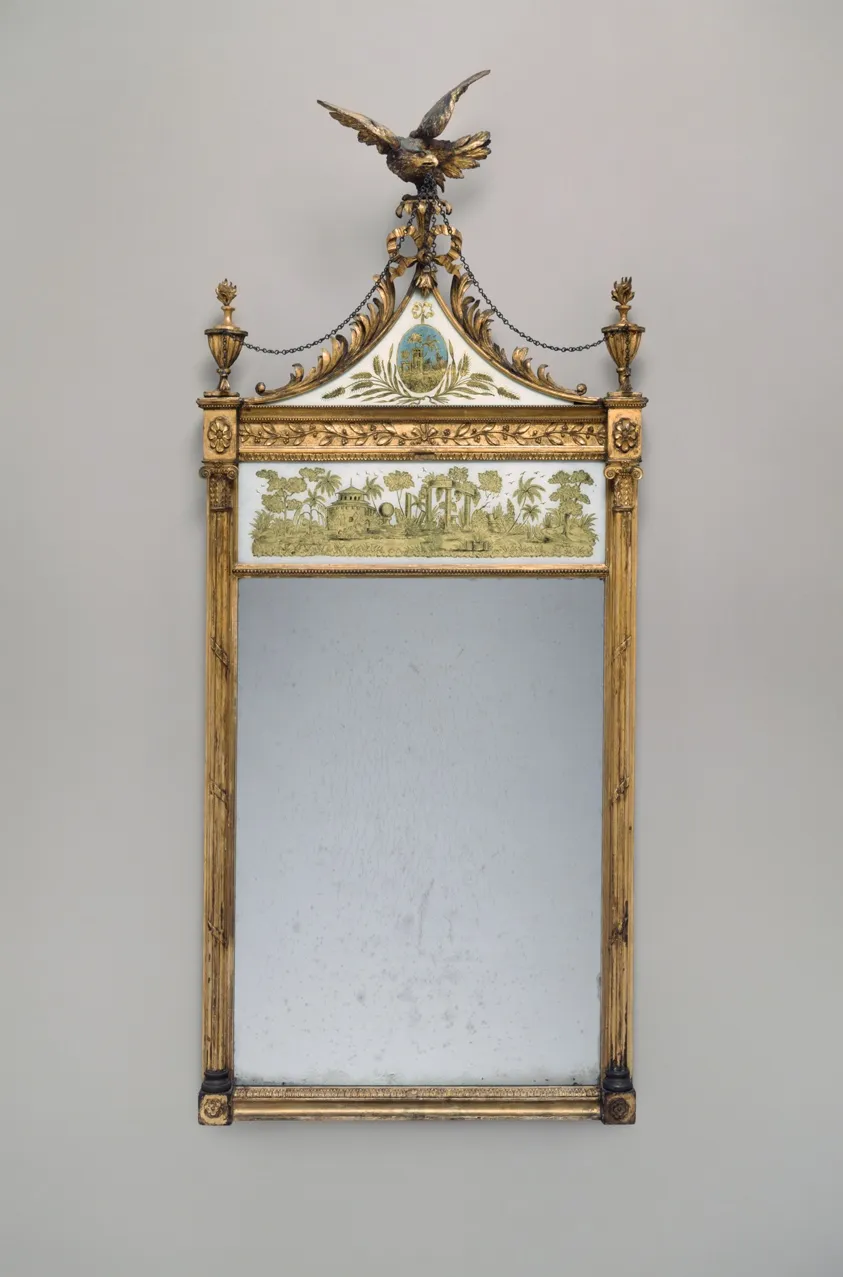
Looking glass, eighteenth century, artist unknown. An antique mirror almost never carries a signature: where it comes from is known from the carving, the gilding and the glass, not from a piece of paper. The trade has the same habit of leaving no trace.
Looking GlassArtist unknown1790–1810 · Art Institute of Chicago · obra 14763 · CC0
The problem is not a shortage of supply
Anyone wanting to buy a period piece in Spain does not have a supply problem. There are excellent galleries and there are antique dealers who have been forty years in the trade. The problem is a different one, and it always turns up in the same place: at the moment of trusting.
Three things that happen and that everybody in the trade knows about:
The price is not shown. «On request» is the default answer. Sometimes there are legitimate reasons — a piece on consignment, a commission — but as a general rule what it achieves is that anyone outside the trade does not dare to ask. A hidden price does not protect the buyer: it keeps them away.
Provenance is not documented. People say «school of», they say «period», they say «attributed», and much of the time they say it correctly. But they rarely say with what degree of certainty, and almost never in writing. The difference between by and attributed to can be ten times the price, and it is exactly the difference that gets blurred most.
The order is sold. This is the one that does most damage, because it cannot be seen. When a listing orders by what each business has paid and does not declare it, it stops being a criterion and becomes an advertisement shaped like a criterion. And whoever consults it believes they are seeing the trade when they are seeing an advertising grid.
Two trades that are not alike
Galleries of modern and contemporary art sit here alongside antique dealers. It is not a comfortable mixture, and we do not make it by oversight.
They do not sell the same thing. The same people do not look for them. A contemporary art gallery and a dealer in early antiques have different clienteles, different fairs and different vocabularies, and putting them in the same drawer would be the first sign that whoever built the directory does not know the ground. That is why the site has two distinct visual worlds and can be walked through entirely by one of them.
What they do share is the standard: an identified professional, a documented piece, provenance with whatever degree of certainty genuinely exists. That standard is the only thing that lets a thousand-euro piece and a hundred-thousand-euro piece be treated with the same seriousness. And it is what separates a professional from the weekend brocante — which has every right to exist and is not this.
What we do differently
It is written into the pact: seven rules, dated and with a change log in plain view. It is there so that it can be quoted and, above all, so that it can be held against us. A commitment that cannot be checked is not a commitment.
The three that matter most to us:
The order is not for sale. No business pays to appear first. If one day there is a paid position, it will say so in the position itself and in those words.
The listing belongs to the professional, not to us. The owner can correct it, claim it or ask us to take it down. It is done the same day, with no explanations required and at no cost. Nobody has to be talked round on the telephone.
The data leaves whenever you want. What a professional brings, they take away whole in a standard file the day they decide to go. A site that holds on to you because getting your data out is a nightmare stopped convincing you a long time ago.
The listings are compiled from public data — the business’s own website, its trade association’s directory — and each one records the address its information came from. The texts are written by us. No text and no photograph is copied from anybody’s website.
What there is today, and what there is not
It would be easy to write this as though the site were finished. It is not, and saying so is part of the deal.
There is today: 38 businesses — 22 galleries and 16 antique dealers — in Madrid, Barcelona, Valencia and Biscay. Six categories with their buying guide, written so that somebody outside the trade knows what to look at before paying. And a set of reference tools: furniture styles, marks of manufacture, how to tell an original from a reproduction.
There is not yet: the rest of Spain, many categories, and selling. Buying through the site is planned for 2027, and its terms will be published in the pact before the first euro is charged, not at the same time.
Nor is anybody signing these texts. We write them and it does not seem honest to invent an author: when somebody from the trade writes, their name will appear.
What we expect from this
That a buyer knows what to ask before walking through the door. And that a professional who works well — who documents, who shows the price, who answers a complaint the same day — has somewhere that this shows against those who do not.
If you are a gallerist or an antique dealer and want to correct your listing, claim it or have it taken down, there is a form and it is resolved the same day. If your business is missing, tell us.
And if you find anything on the site that contradicts what you have just read, what we want is to know. That is what the dated pact is for.